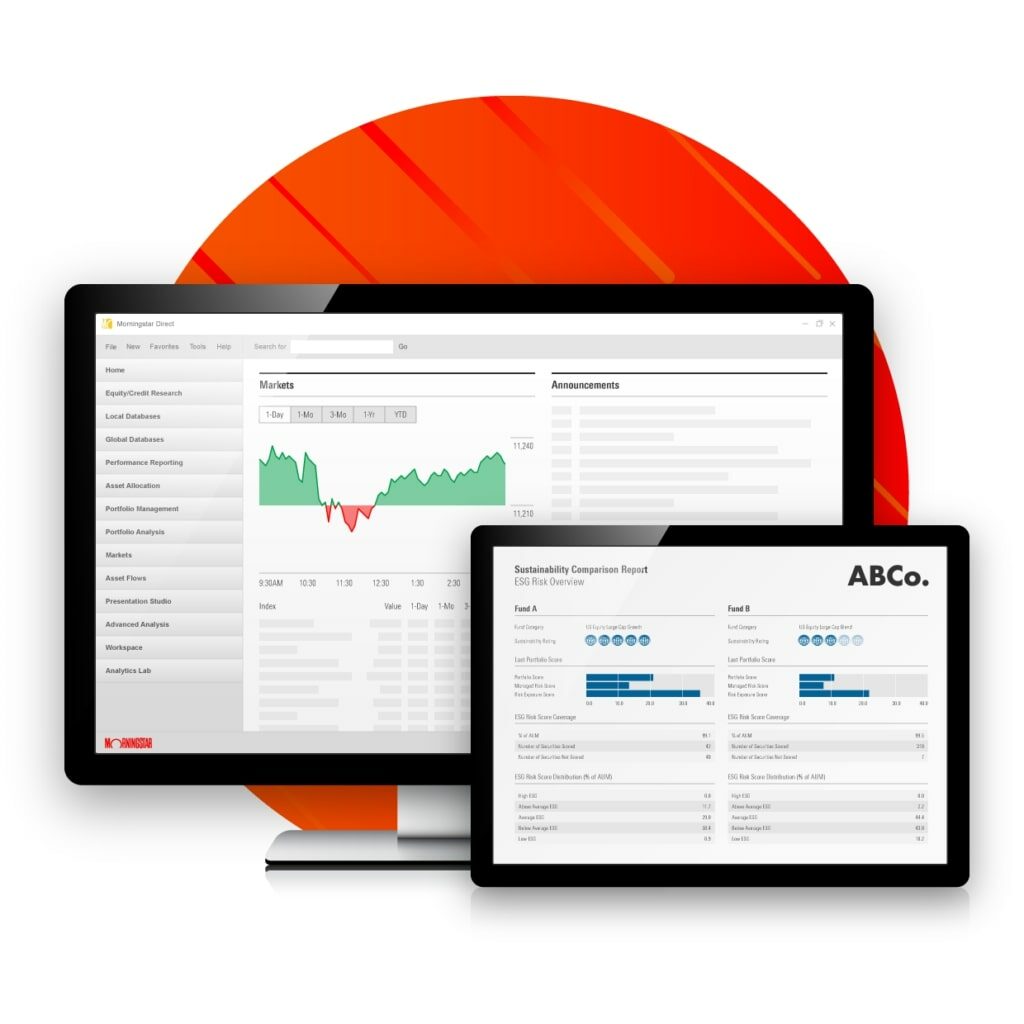
Seeking Alpha and Morningstar are popular sites for investors to research investments, choose stocks and ETFs to buy, and monitor investments in their portfolios.
Other services may have better charting tools, cover more securities, or use AI for trading opportunities, but Seeking Alpha and Morningstar always seem to be in the mix when people talk about the best stock research platforms.
To the untrained eye, Seeking Alpha and Morningstar look like they do a lot of the same things.
Both have a wealth of information and research. Both are well-known and highly regarded. And both provide investors with an array of investment analysis tools.
Since they have so much in common, it may be challenging to compare Seeking Alpha vs Morningstar, but we’re here to simplify the process and help you choose the right research platform for your needs.
In this review, we’ll talk about features, including what’s new, and help you understand which platform is best suited for your investment style. For example, we’ll explain who creates the content, and who can benefit the most from using it: experienced investors who like to do extensive research, or those who want a quick overview.
Will Seeking Alpha or Morningstar give you the biggest bang for your buck? Which offers more value and which will help you max out the returns on your investments?
Let’s compare Seeking Alpha and Morningstar to choose the best tool for your investment portfolio.
Seeking Alpha vs Morningstar: Overview
If you’re someone who likes to research investments before you buy, both Seeking Alpha and Morningstar have something to offer. Here’s our quick overview of each.
Seeking Alpha offers a huge volume of analysis from community members and experts. It bills itself as the world’s largest investment community.
Premium members get access to unlimited community-created content. Not all community content is vetted, but Seeking Alpha’s author ratings make it easy to separate the wheat from the chaff.
It’s easy to do a deep dive on investments with Seeking Alpha. In addition to tons of analysis, there are also research tools such as pre-set and custom screeners, watchlists, investing groups, Portfolio Health Scores (a new feature), and Seeking Alpha’s proprietary Quant ratings, which have an impressive record when compared to the S&P 500. (If you want to do a deep, deep, deep dive into this read our Seeking Alpha Quant Rating Review).
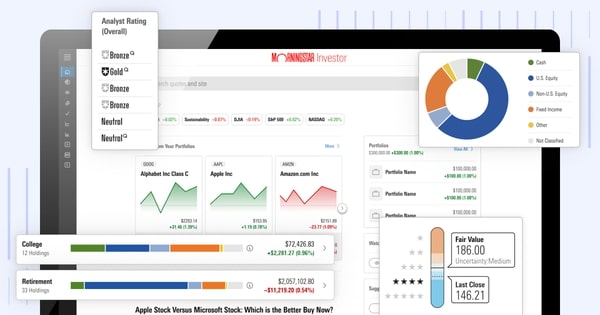
Morningstar offers analysis from a select group of ~150 analysts but lacks the community aspect of Seeking Alpha. It also offers screeners, professional ratings with transparent methodology, portfolio X-ray, and account integration. That last one is something Seeking Alpha lacks.
Seeking Alpha vs Morningstar: How Do They Work?
Part of the evaluation process when choosing an investment research platform is reviewing how each platform works and its core functions. Both Morningstar and Seeking Alpha have a lot to offer, but there are some important differences that may help investors decide which to spend their money on.
Core Functionality Points for Seeking Alpha
We’ll start with Seeking Alpha, which has some unique offerings you won’t be able to find anywhere else.
Crowdsourced investment insights. Seeking Alpha is, above all, an investment community. Any community member can post analysis and articles for fellow members to read. Community members can rate one another’s content.
Quant Ratings for detailed stock evaluations. Seeking Alpha’s Quant Ratings are on a scale of 1 to 5, with a 1 being a “Strong Sell” and a 5 being a “Strong Buy.”
Expert articles and opinions. In addition to community articles, Seeking Alpha offers expert articles and opinions written by vetted Authors.
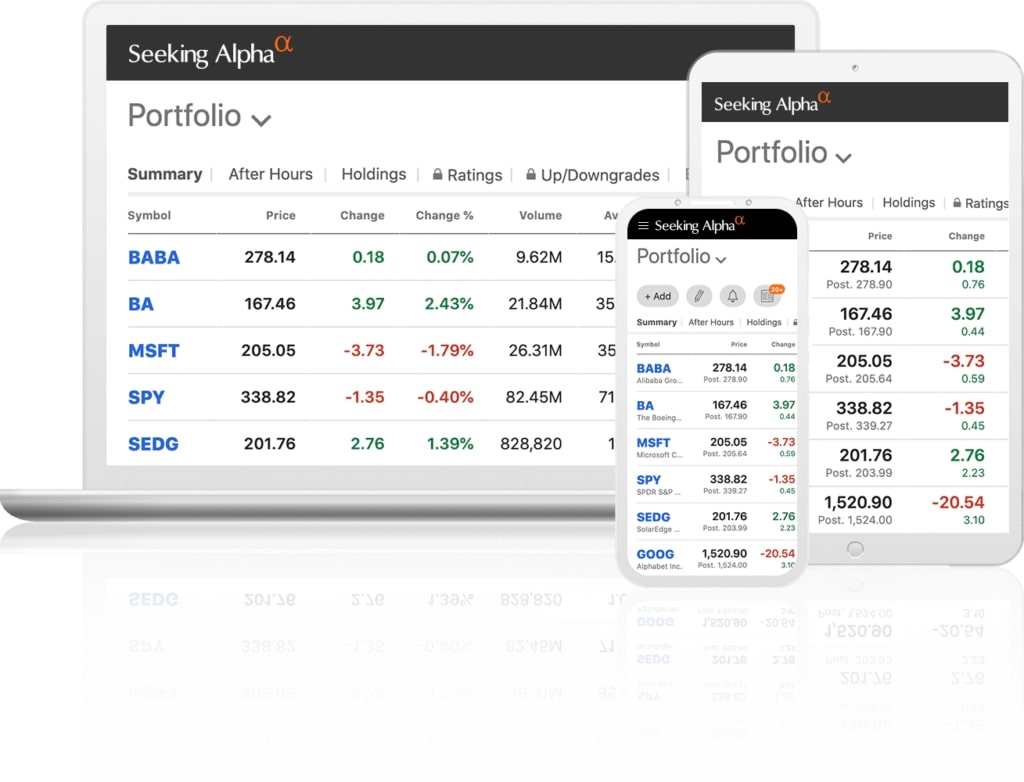
Personalized stock alerts and watchlists. Any Seeking Alpha subscriber has the option to create a portfolio and set up personalized alerts and watchlists to stay abreast of market developments. (We should note that you can’t link to a portfolio with Seeking Alpha; instead, you’ll create a portfolio to mirror your actual investments.)
Portfolio management tools including a Portfolio Health Score and the ability to link your portfolio and get instant updates when your stocks Quan Rating changes.
Our take is that Seeking Alpha is ideal for intermediate to advanced investors who want access to as much research as possible to help them make decisions about what to buy and sell.
120+ global analysts covering ~1,000 stocks with fair value estimates
Advanced stock, fund & ESG screeners with 200+ data points
Access via web, iOS & Android, with watchlists and portfolios syncing across devices
Morningstar takes a different approach to investment research, with a focus on expert-created content. Here’s what you’ll find if you decide to subscribe.
Comprehensive financial data. If you’re someone who wants access to financials, stock performance, and more, you can find a lot of the data you need on Morningstar. That includes data on bonds and mutual funds, neither of which are available on Seeking Alpha.
Analyst ratings and reports. You can get access to tons of analyst ratings and reports on Morningstar, There’s a lot of data and analysis to be found, including articles written by 150+ professionals whose job it is to help subscribers get the information they need about stocks, ETFs, mutual funds, and bonds.
Portfolio management tools. Morningstar subscribers get access to an array of portfolio management tools, including the Portfolio X-Ray tool, which makes it easy to balance your portfolio and avoid overinvesting in any one stock or sector.
Comparing Morningstar and Seeking Alpha, we’d say that Seeking Alpha’s most unique features are its investment community and Quant ratings, while Morningstar offers research on some investments that Seeking Alpha doesn’t.
Seeking Alpha vs. Morningstar: Key Features
We can’t tell you what investment research features to prioritize.
What we can do is provide you with the key features of both Seeking Alpha and Morningstar, so you can get a handle on what’s available and decide what you want to do.
Key Features for Seeking Alpha
Let’s start with Seeking Alpha. We’ll provide a list of the features of each, then give you a comparison table so you can make an evaluation.
Here are the key features for Seeking Alpha subscribers.
Quant Ratings are Seeking Alpha’s proprietary ratings, based on an investment’s value, growth, profitability, EPS Revisions, and price momentum. Investments that have received a “Strong Buy” rating have outperformed the S&P 500 by almost 7x.
Dividend Safety Ratings are an evaluation that lets investors know how dividend stocks have performed over time and how likely they are to deliver earnings in the future.
Portfolio management tools include ratings & price alerts, a Portfolio Health Grade, stock screeners, and watchlists.
Access to 10 years of financials and earnings call transcripts provides investors with the option to take a deep dive into a company’s performance.
Quant rating and price alerts allow subscribers to get notified when an investment’s Quant rating or price changes based on their specifications.
Customizable watchlists make it easy to keep an eye on investments and act quickly when necessary.
Personalized article alerts allow users to follow their favorite authors and never miss what they post.
Seeking Alpha offers 2 paid service. Their Premium service allows you access to their Quant Ratings on each stock. Here you see a recent quote of Apple and is Quant Rating.
And they also offer a stock recommendation service that gives you their 2 highest rated stocks each month. This service is called Alpha Picks and it has performed phenomenally since its launch in mid 2022.
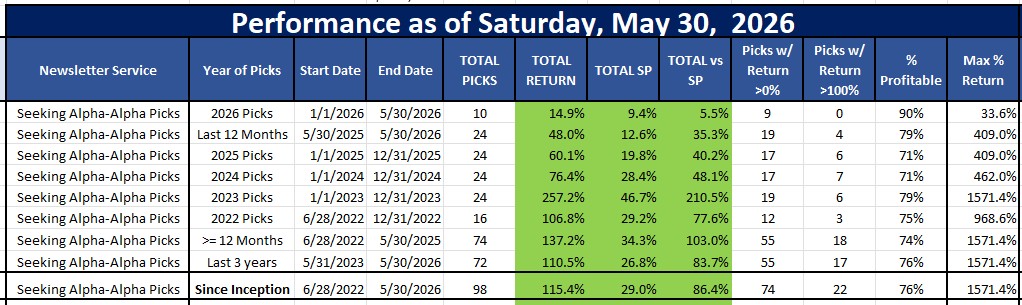
Here's a summary of Alpha Picks' performance for each year since inception as of May 31, 2026 to give you an idea if it is worth it.
While the markets have recovered from the Iran war and continue to set records, so too have Alpha Picks as they continue to easily beat the market's performance. My analysis speaks for itself on the value of their Alpha Picks service. These returns prove it has been providing huge gains over the S&P since its launch with a lifetime BEAT of the S&P of all their picks of 83.7%. Some might think it is a little pricey at $499 a year, but think of it this way. If you have at least $10,000 in the market and you can improve your return by 5% a year then it pays for itself ($10,000 x 5% = $500). Obviously if you have more than $10,000 in the market then it is a no-brainer. Look at this chart and it will convince you that you need Seeking Alpha. Like I said, I have been a subscriber since 2022.
Alpha Picks Update as of May 31, 2026: Since its launch in July, 2022, the 98 Alpha Picks from 2022 thru 2026 are now up an average of 115.4% and are easily beating the S&P500's average return of 29% by 86.4%. And 9 of 10 of their 2026 picks are up as you can see.
Incredibly, of their 24 picks in the last 12 months, 1 is up 409%, 1 is up 230% and 2 other have doubled. WOW! But most impressively, their picks that are at least 12 months old are now up 137% vs 34% for 103% ALPHA. Yes, these picks are over 4x the SPY. If you want to improve your chances of beating the market, I haven't found a more reliable service.
Imagine if you could plug your entire portfolio into a data-driven tool that flags buys and warns you when to sell.
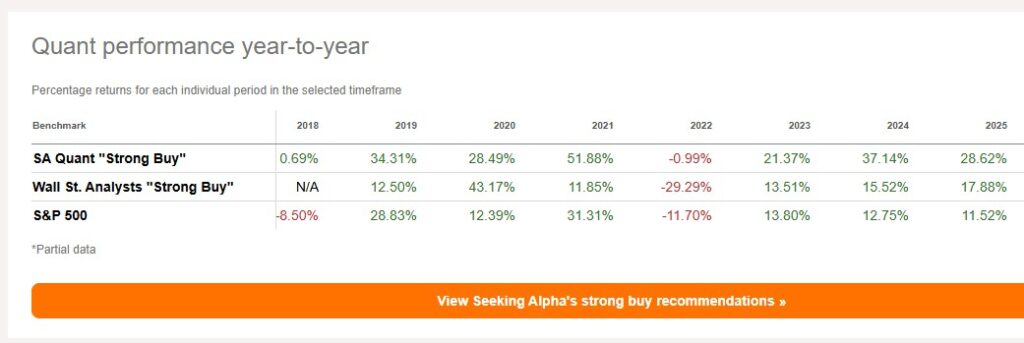
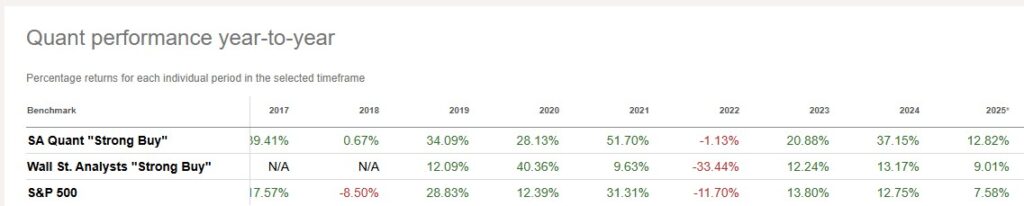
One of Seeking Alpha's most powerful features is their Quant Rating on each stock. This system grades every stock daily using over 100 fundamental and technical metrics. Since 2017, the “Strong Buy” stocks have consistently outperformed both Wall Street analysts and the overall market. Just look at 2024: Quant Strong Buys gained 37.15%, compared to just 12.75% for the S&P 500:
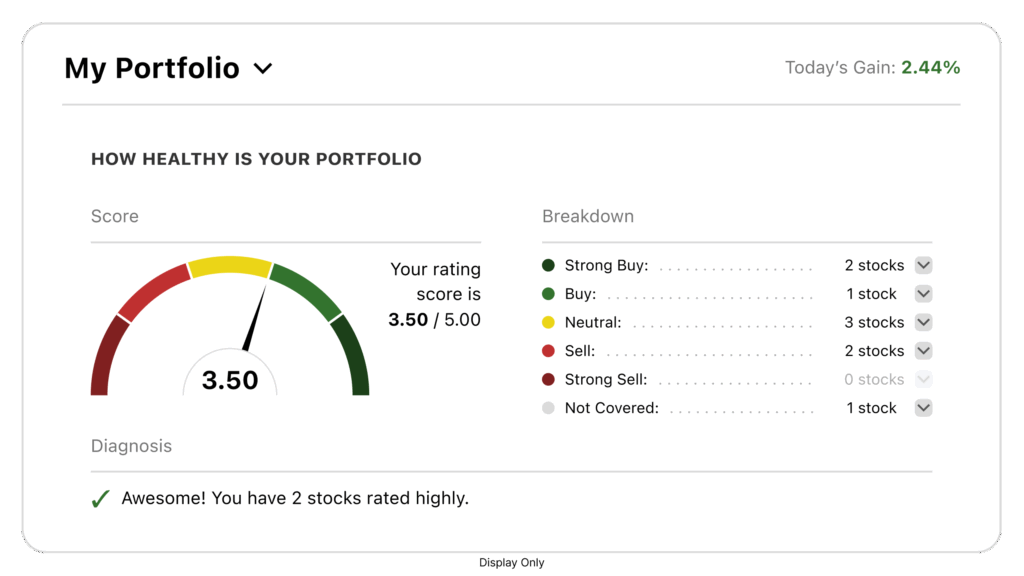
The Quant Rating is an incredible stock screener on its own, but the real game-changer is pairing it with the My Portfolio tool.
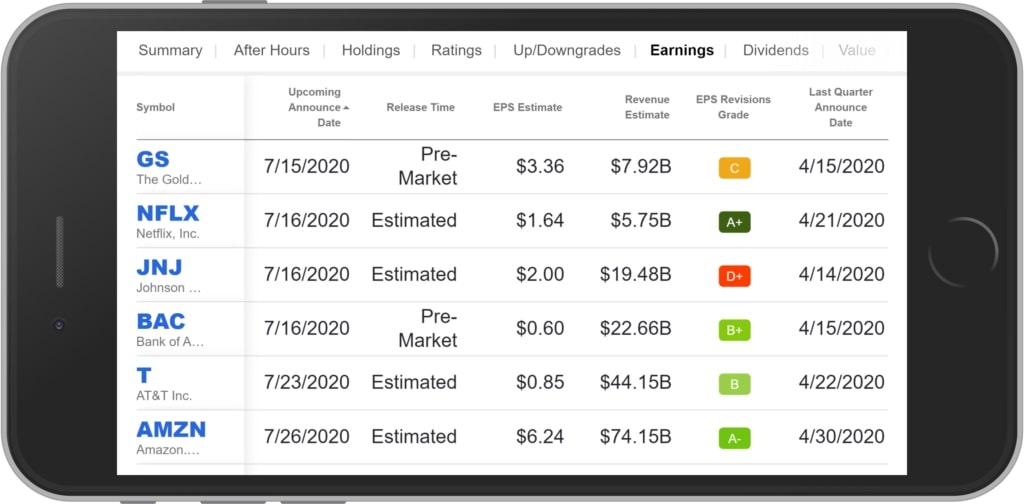
Using Seeking Alpha Premium, I connect my brokerage accounts and track Quant Ratings across my entire portfolio in one simple dashboard. That means I get instant alerts when any of my holdings drop to a “Sell” or “Strong Sell.” I personally use it to know when it’s time to take profits—or tighten stop-losses—before a stock turns into dead weight.
It looks like this:
The combination of proven outperforming stock picks and personalized portfolio monitoring is why so many investors swear by Seeking Alpha Premium.
Subscribers to Morningstar also get access to a host of useful features. Here are the most important.
Comprehensive financial data on stocks, ETF, bonds, and mutual funds, including detailed information about performance and earnings.
Independent analyst ratings and reports, including Morningstar’s proprietary ratings and professional analysis to help subscribers evaluate potential investments.
Portfolio management tools, including watchlists, alerts, and Portfolio X-Ray.
Stock and fund screeners to make it easy to find investments.
Investment planning tools.
Here’s our side-by-side comparison:
Feature
Seeking Alpha
Morningstar
Proprietary Ratings
Y
Y
Investment Community
Y
N
Expert Analysis
Y
Y
Stock Screeners
Y
Y
Watchlists
Y
Y
Stock and Rating Alerts
Y
Y
Investing Groups
Y
N
Portfolio Management Tools
Y
Y
Professional Analysis
Y
Y
Dividend Safety Ratings
Y
N
Seeking Alpha vs Morningstar Features
How Much Does Morningstar Investor Cost?
Morningstar’s consumer plan is Morningstar Investor (it replaced the older “Morningstar Premium”). Here’s the current pricing:
Plan
Price
Notes
Monthly
$34.95/mo
Cancel anytime; ~$419/yr
Annual
$249/yr
~$20.75/mo — about 41% cheaper than monthly
Annual with discount
~$199 first year
$50 off for new members, via the offer below
Free trial
7 days
Full premium access
There’s no permanent free tier, but the 7-day free trial gives full access so you can test Portfolio X-Ray, the screeners, and analyst reports before paying. New subscribers currently get $50 off the first year, bringing the annual plan to about $199. Just note it auto-renews at $249, so set a reminder if you want to reassess.
Seeking Alpha has four subscription tiers, as follows.
Free plan: Limited features allow users to create a portfolio, set up alerts, check real-time stock prices, get access to some community articles, and read one Premium article per month.
Premium plan: Get access to Quant ratings, all community-created and most expert-created content, screeners, watchlists, investment groups, rankings of top stocks and ETFs, and Portfolio Health Score. There’s a one-week free trial. After that, the annual subscription for first-timers is $299.
Pro plan: Get access to everything in the Premium plan plus top analyst insights, top stock rankings, VIP customer service, short ideas, and upgrades & downgrades. There’s a $99 one-month trial, after that the annual cost is $2,400.
Alpha Picks: This is their stock recommendation service where you get 2 picks a month and they charge $499 a year for this service, but as you saw above it is really worth it.
Best Discounts for September, 2026:
Seeking Alpha has become so successful in the last few years that they rarely discount their services. But they currently are running a 10% Summer Sale on the promo pages below (sale ends at the end of this month). This is one of their biggest discount of the year so far. Here's your chance to get a free trial, save 10% AND get their next stock pick in real-time:
Here are some pros and cons of each service, starting with Seeking Alpha.
PRO: Extensive financials and analysis, including over 1 million community “ideas” and 10 years of financials
PRO: Pre-set and custom screeners
PRO: Pre-set and custom watchlists
PRO: Quant ratings have consistently outperformed the S&P 500
PRO: Excellent choice for expert investors who want access to the most data
CON: Past performance of “Strong Buy” stocks isn’t a guarantee of future performance
CON: Can’t link to actual portfolio
Now for Morningstar:
PRO: Expert analysis on stocks, ETFs, bonds, and mutual funds
PRO: A decent selection of screeners and graphics to help investors evaluate before they buy or sell
CON: The interface leaves something to be desired
CON: Customer service could be better
Overall, we think the Pros of Seeking Alpha make it the superior choice. Even investors who don’t want to do a deep research dive can find value in the Quant Ratings, Portfolio Health Grade, Screeners, Watchlists, and other features.
Seeking Alpha vs. Morningstar: Conclusion
So, which one should you actually pay for?
These two tools are built for different investors, and the honest answer is that the “winner” depends on how you invest. Here’s how we’d decide.
Choose Morningstar if you:
Invest in mutual funds, ETFs, or bonds (Seeking Alpha barely covers these)
Are a long-term or retirement investor building and balancing a portfolio rather than trading individual names
Want independent, conflict-free analyst research, fair-value estimates, and economic-moat ratings
Want Portfolio X-Ray to see your true diversification, overlap, and fees
Our bottom line: For most people building wealth for the long haul — fund and ETF investors, retirement savers, and anyone who wants one trustworthy research platform as the core of their process — Morningstar Investor is the better long-term value, especially with the 7-day free trial and $50 off to test it risk-free. Seeking Alpha is the stronger pick if you’re an active stock-picker who lives in individual names and wants Quant Ratings and community analysis. Plenty of serious investors keep both — but if you’re starting with one, match it to the lists above.
Best Discounts for September, 2026:
Seeking Alpha has become so successful in the last few years that they rarely discount their services. But they currently are running a 10% Summer Sale on the promo pages below (sale ends at the end of this month). This is one of their biggest discount of the year so far. Here's your chance to get a free trial, save 10% AND get their next stock pick in real-time:
It depends on your style. Morningstar is the stronger choice for fund, ETF, bond, and long-term/retirement investors who want independent analyst research and portfolio tools. Seeking Alpha is better for active stock-pickers who want Quant Ratings and community analysis.
Is it worth paying for Seeking Alpha?
We think it is. The free version offers an extremely limited set of features, but with the Premium plan, you’ll get access to everything you need to research investments and make smart choices. Plus, the free trial gives you a full 7 days to try out Seeking Alpha’s Premium features before you commit to the annual subscription.
How much does Morningstar cost?
Morningstar Investor is $249/year or $34.95/month, with a 7-day free trial. New subscribers currently get $50 off the first year (~$199).
Does Morningstar have a free trial?
Yes — a 7-day free trial with full premium access. You can cancel before it ends if it’s not for you.
Does Seeking Alpha outperform the market?
Historically, the answer is yes. Stocks with a “Strong Buy” Quant rating (anything over 4.5) have outperformed the S&P 500 by more than 400% over the past 14 years. Keep in mind that past performance isn’t a promise of future results. Their Seeking Alpha Picks service is also crushing the market. See our Alpha Picks Review.
Do people make money on Seeking Alpha?
No investment research platform can promise results, but people who focus on buying Seeking Alpha’s “Strong Buy” picks consistently have done very well.
Rank of Top Stock Newsletters Last 3 Years, as of June 27, 2026
We are paid subscribers to dozens of stock and option newsletters. We actively track every recommendation from all of these services, calculate performance, and share our results of the top performing stock newsletters whose subscriptions fees are under $500. The main metric to look for is "Return vs S&P500" which is their return above that of the S&P500. So, based on June 27, 2026 prices:
Summary: 2 picks per month based on Seeking Alpha's Quant Rating; consistently beating the market every year since launch; tells you when to sell and they have sold almost half. See complete details in our Alpha Picks Review. Or get their Premium service to get their QUANT RATINGS on your stocks to better manage your current portfolio--read our Is Seeking Alpha Worth It? article to learn more about their Quant Ratings.
Summary: 10 stock picks per year on January 1st based on Zacks' Quant Rating; Retail Price is $495/yr and includes 6 different services including those below. Read our Zacks Review.
Summary: 10 stock picks per year on January 1st based on Zacks' Quant Rating; Retail Price is $495/yr and includes 6 different services. Read our Zacks Review.
Summary: All it requires is an email address to get their #1 stock pick free; 60+ stock picks per year, segmented by industry; consistently beating the market every year; retail price is $365/yr but save try it for $99. Read our Moby Review.
Summary: About 1 pick/week focusing on short term trades; Lifetime average return of 355% vs S&P500's 149% since 2015. Retail Price is $379/yr. Read our TipRanks Review.
Summary: 2 picks/month and 2 Best Buy Stocks lists focusing on high growth potential stocks over 5 years; Retail Price is $199/yr. Read our Motley Fool Review.
Summary: Rule Breakers is included with the Fool's Epic Service. Get 5 picks/month focusing on disruptive technology and business models; Lifetime average return of 355% vs S&P500's 149% since 2005; Now part of Motley Fool Epic. Read our Motley Fool Epic Review.
Top Ranking Stock Newsletters based on their last 3 years of stock picks covering 2026, 2025, 2024, and 2023 performance as compared to S&P500. S&P500's return is based on average return of S&P500 from date each stock pick is released. NOTE: To get these results you must buy equal dollar amounts of each pick on the date the stock pick is released. Investor Business Daily Top 50 based on performance of FFTY ETF. Performance as of April 5, 2026.