Every investing app seems to have AI in it now. Some answer questions about your portfolio, some research stocks for you and some quietly manage the whole thing. None of them can tell you what the market will do next, and the good ones say so up front.
We picked three AI investing apps that each do a different job: Robinhood for trading, Tykr for stock research and Betterment for hands-off investing. We used Tykr’s AI Helper ourselves and went through each company’s own pages for what its AI can and can’t do. Before you hand any app your money, the SEC’s investor alert on AI and investment fraud is a quick, useful read.
In this article, we’ll compare the three side by side, show you what each AI actually does and help you pick the one that fits how you invest.

Get a FREE stock worth up to $200 the moment you fund a new account with just $10, plus up to $15,000 more per year in free stock when you refer friends. U.S. residents only.
- U.S. stocks, ETFs, options, and cryptos, all commission-free
- Excellent for beginners and advanced investors
- Cash management account and credit card
- Upgrade to Gold for better rates on cash, margin, and a 3% IRA contribution match
- SIPC protected up to $500,000, plus FDIC coverage on uninvested cash
- Connect your favorite AI agent directly to your account and let it research, monitor, and trade for you with a dedicated funded account and a one-tap kill switch you control
- Predictive Markets: Trade real-time "Yes/No" event contracts on sports, politics, weather, and finance. Put your read on the world to work, with instant settlement when the outcome hits
Open and fund a Robinhood account, then try its AI tools
The best AI investing apps at a glance
| Robinhood | Tykr | Betterment | |
|---|---|---|---|
| Best for | Active investors | Beginners researching stocks | Hands-off investors |
| What the AI does | Answers portfolio questions, builds screeners, drafts orders; AI agents can trade for you | Compares stocks, explains its ratings, builds and analyzes portfolios | Flags concentration in a portfolio you build |
| You still | Review and submit trades | Make every buy and sell decision | Pick the holdings, or start from its models |
| Cost of the AI | Cortex needs Gold, $5 a month (first 30 days free) | Included in plans from $14.99 a month after a 30-day free trial | Custom portfolios, 0.25% a year |
| Places trades? | Yes, it’s a broker | No, connects to your broker | Yes, inside your Betterment account |
The three don’t really compete. Tykr helps you decide what to buy, Robinhood is where you buy it, and Betterment is for the money you’d rather not think about. You might end up using two of them.
Robinhood: the best AI trading app for active investors
Robinhood has two separate AI tools, and they work very differently. One answers your questions. The other can trade for you.
Robinhood Cortex
Cortex is a chat assistant built into the Robinhood app. You can ask it how your portfolio is doing, what a dividend is or why a stock moved today, and it answers in plain English using market data and research reports. You can type or talk to it.
The handiest part is stock discovery. Ask for something like “large-cap stocks with low P/E ratios” and Cortex builds the screener for you, shows the criteria it used and suggests filters to narrow the list. It can also set up market, stop and limit orders from a conversation, though you always review and submit the trade yourself.
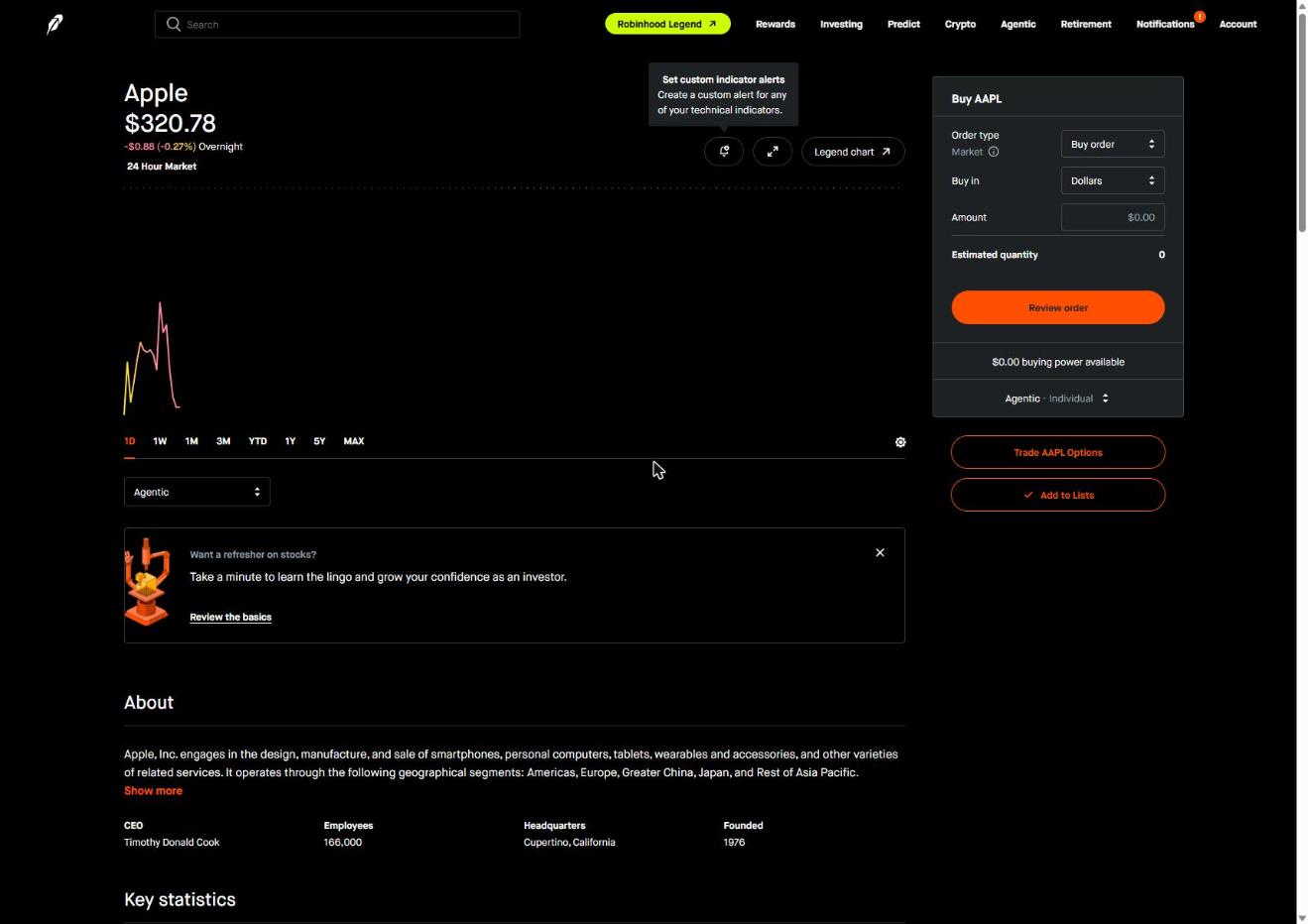
Robinhood is clear about the limits. Cortex won’t give buy or sell recommendations, won’t predict prices and can’t browse the web or read Reddit. Two catches before you sign up for it: Cortex is only for Robinhood Gold members, and it’s only on the iPhone app right now.
Robinhood Agents
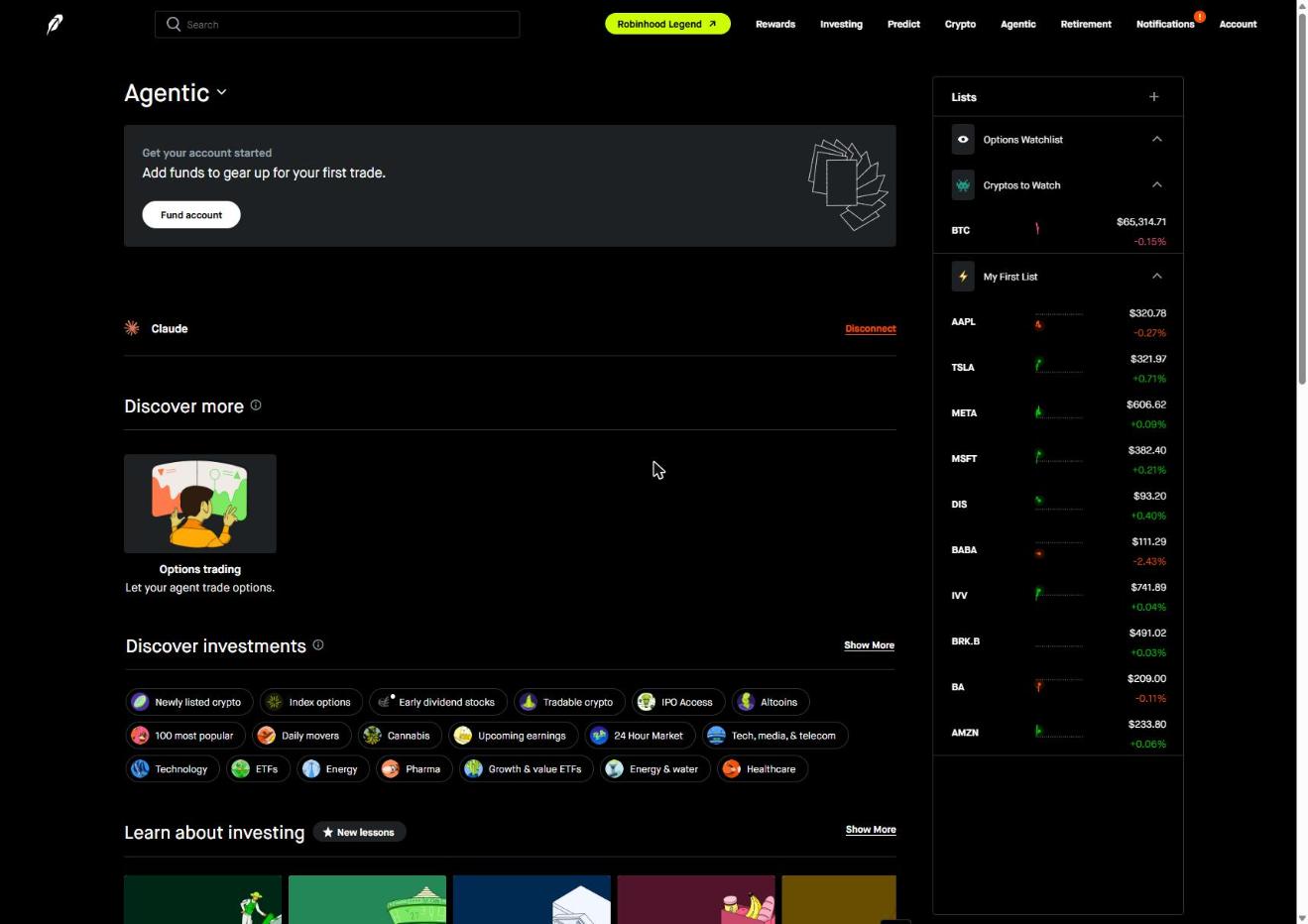
This is the bigger leap. Robinhood Agents lets you set up an AI agent that can scan the market, review your portfolio, build watchlists and place trades. It trades from its own dedicated account, so you fund it separately from your main portfolio, and you can connect an outside agent through Robinhood’s MCP server too.
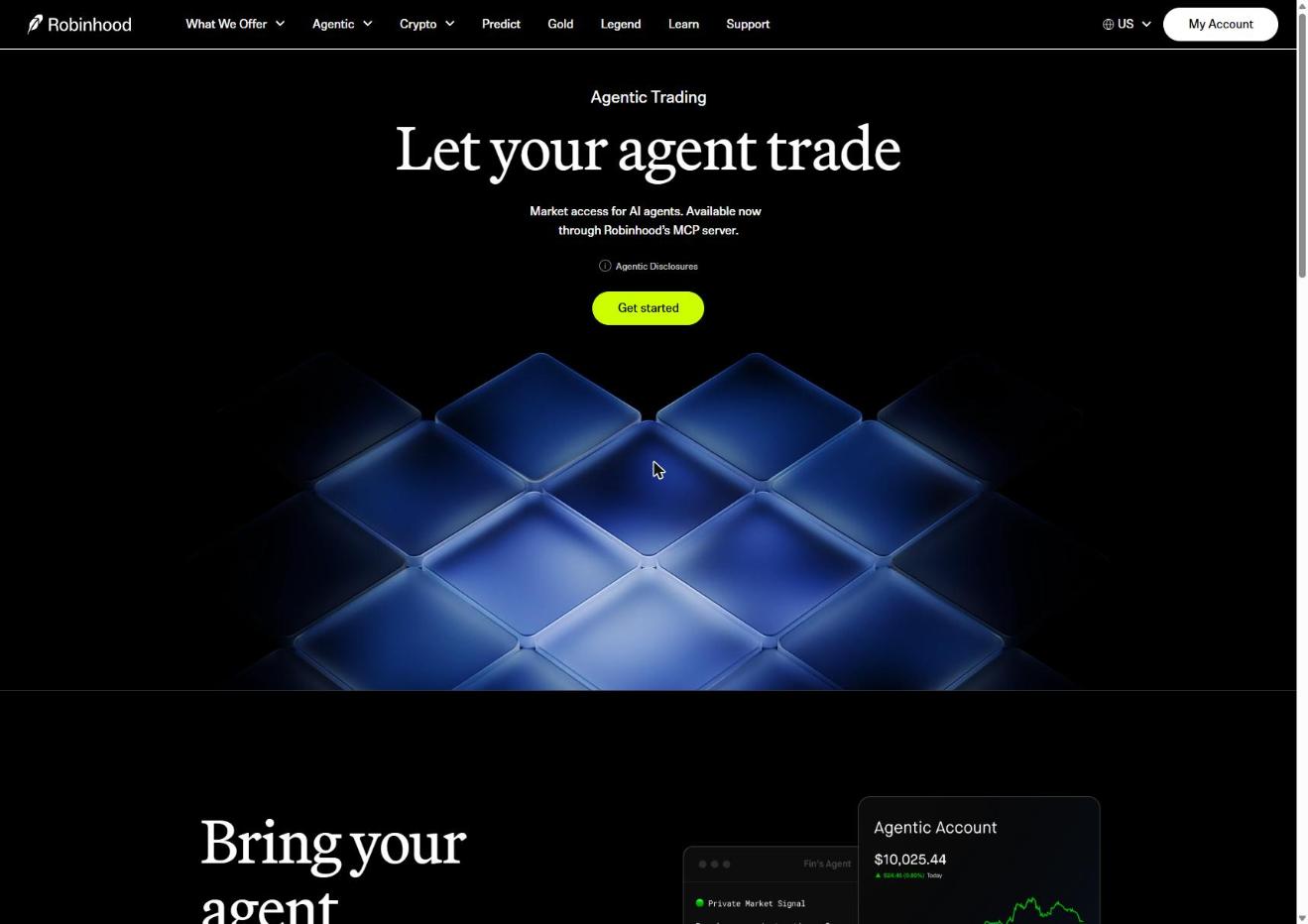
Trade approvals are switched on by default, so the agent asks before every order until you decide otherwise. Keep them on while you learn how your agent behaves. Robinhood’s own disclosure says agents can make errors and act on outdated information, and that you could lose your entire investment, so start small. We tried it with real money in Robinhood Agentic Trading: I Gave an AI Agent $1,000.
What it costs
Opening a Robinhood account is free. Gold costs $5 a month, and your first 30 days are free. Besides Cortex, Gold pays 3.6% APY on eligible brokerage cash with no cap.
New customers also get a gift stock once they’re approved and link a bank account or debit card. It’s worth anywhere from $5 to $200, though about 99% of people get $5. It’s a nice bonus, but it shouldn’t be the reason you choose a broker.
Fund a Robinhood account and see what its AI can do
Tykr: the best AI investing tool for beginners
Tykr isn’t a broker. It’s a stock research app that rates every stock On Sale, Watch or Overpriced, based on a Score out of 100 and a margin of safety. We covered how those ratings work in our full Tykr review. What’s new here is the AI Helper, and we tested it.
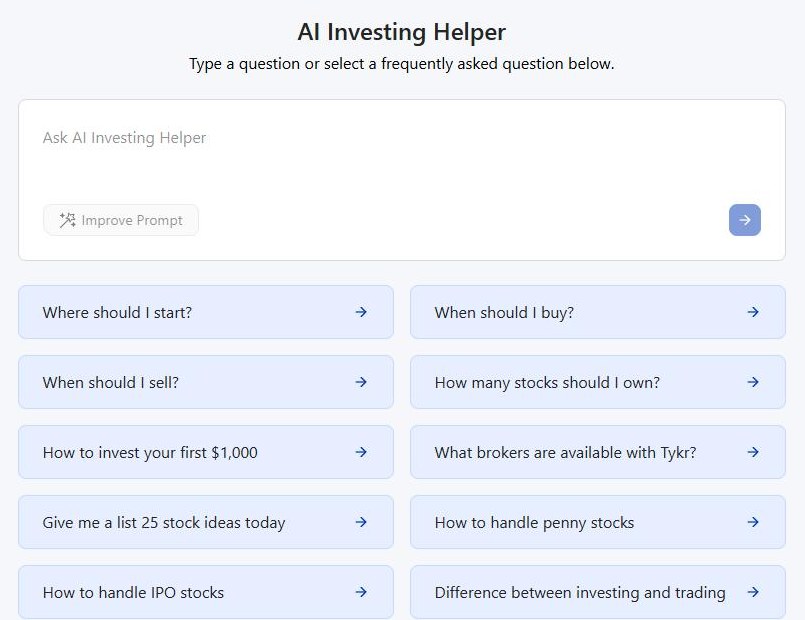
The AI Helper has three modes: an Investing Helper for questions, a Portfolio Builder and a Portfolio Analyzer. You can type your own question or pick from a list of starters like “When should I buy?”, “How to invest your first $1,000” and “Compare AAPL and MSFT”.
We asked it to compare Apple and Microsoft. In under a minute it came back with Tykr’s ratings for both, then a detailed table of fundamentals including P/E, debt-to-equity, profit margin and return on invested capital, all pulled from that day’s data.
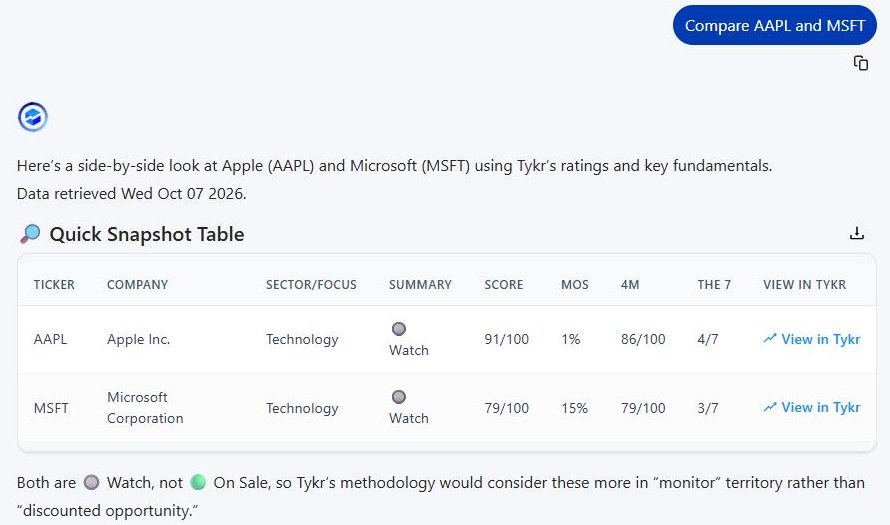
Both came out as Watch. Apple had the higher Score, 91 against 79, but Microsoft had the bigger margin of safety at 15% against Apple’s 1%. The AI then walked through what that means in Tykr’s terms: both are stocks to monitor, not stocks that look cheap right now. That’s useful for a beginner, because it explains the rating instead of just showing it.
Tykr also publishes a performance figure on its homepage: it says that over the last five years, the S&P 500 returned about 12% a year and Tykr returned about 16% a year. Tykr adds that returns aren’t guaranteed, and that’s the right way to read it. Past results don’t tell you what a rating system will do next.
AI questions run on credits, with 30 on the Premium plan. Premium costs $14.99 a month or $99.99 a year after a 30-day free trial. Tykr also connects to more than 40 brokers, Robinhood included, so you can see the rating on every stock you already own.
Ask Tykr’s AI Helper about your stocks, free for 30 days
Betterment: the best AI investment platform for hands-off investors
Betterment is a robo-advisor. It builds a portfolio of ETFs for you, then rebalances it, reinvests dividends and harvests tax losses automatically. That’s been its job for years. The AI part is newer.
With Betterment’s custom portfolios, you pick your own stocks and ETFs, or start from one of its model portfolios and change it. As you build, Betterment’s AI checks your allocation, sector exposure and geographic exposure and points out where you’re concentrated. If half your money ends up in tech without you noticing, it’ll tell you. Custom portfolios are only available in individual taxable accounts for now, with IRAs and joint accounts coming later.
It doesn’t make recommendations, and it doesn’t look at your wider finances or accounts outside Betterment. Think of it as a second pair of eyes on a portfolio you’ve designed.
Pricing is simple. Investing accounts cost $5 a month, or 0.25% a year once you set up $200 or more in monthly deposits or your balance reaches $24,000. Premium, with access to a human advisor, is 0.65% a year.
Do AI investing apps actually work?
They work for what they’re built to do. All three apps here save you time: Cortex builds a screener in seconds, Tykr’s AI explains a rating you’d otherwise have to decode, and Betterment spots a concentration you might have missed.
What none of them do is predict the market. Robinhood says Cortex can’t predict future price moves. Betterment says its insights don’t include recommendations. Tykr calls its ratings a starting point. If an app promises you’ll beat the market with AI, that’s the kind of pitch the SEC’s alert above warns about.
Which AI investing app should you use?
If you like to pick your own stocks and want help doing it, start with Tykr. The AI Helper is the friendliest way we’ve found to understand what a stock’s numbers are telling you.
If you trade actively, or you’re curious about letting an AI agent trade a small account for you, Robinhood is the clear pick. Its AI tools do the most of the three, and it’s the only one where an agent can place trades.
If you’d rather not manage anything, Betterment does the work and its AI keeps an eye on the balance.
Our favorite setup uses two of them together. Connect your Robinhood account to Tykr, research there, then place your trades in Robinhood. You get the ratings and the AI explanations on one side and a full-featured broker on the other!
Open a Robinhood account and make your first deposit today
FAQs
They’re good at saving you time: building screeners, explaining ratings and spotting concentration in a portfolio. None of them can predict the market, and Robinhood, Betterment and Tykr all say their AI doesn’t make that kind of call.
Tykr is the most beginner-friendly of the three we compared. Its AI Helper answers starter questions like how to invest your first $1,000 and explains its stock ratings in plain English. It comes with a 30-day free trial.
Not entirely. Robinhood Cortex is only available to Robinhood Gold members, which costs $5 a month after a free first 30 days. Opening a regular Robinhood account doesn’t cost anything.
AI can screen and compare stocks, and with Robinhood Agents it can even place trades from a dedicated account. The decisions and the risk are still yours, and no AI tool can tell you which stock will go up.
Robinhood is a registered broker-dealer and SIPC member, and Betterment holds your investments in a Betterment Securities brokerage account. The bigger risk is fake AI trading platforms that promise you can’t lose money, which the SEC warns about in its investor alerts.