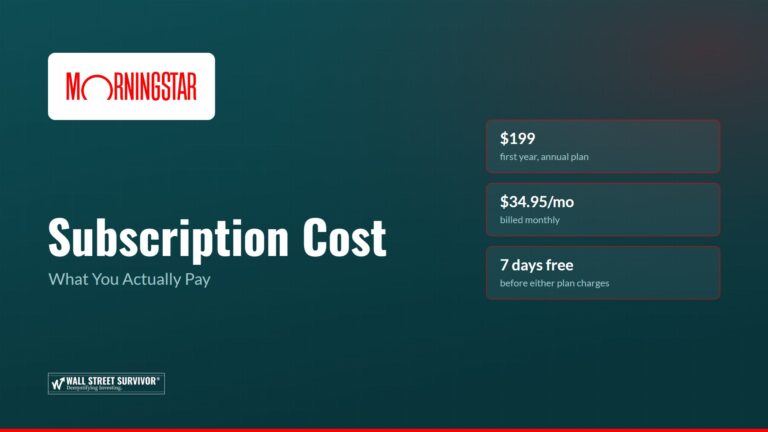
Morningstar Investor costs $34.95 a month, or $199 for your first year if you pay annually, down from a $249 list price. That annual rate works out to $16.58 a month, and Morningstar’s own page calls it a 53% saving over paying monthly. Both plans start with a seven-day free trial before any charge lands. We confirmed these figures on Morningstar’s site on 14 September 2026, and the fine print says the rate can change without notice.
So that’s the price. What it doesn’t tell you is what you actually get, how the first-year discount is conditioned, who qualifies for the cheaper rates, and whether $199 makes sense for the way you invest. We’ll go through all four. And if you are weighing this against what investing already costs you, the SEC’s glossary of mutual fund fees and expenses is a good yardstick: one extra percentage point of expense ratio on a modest portfolio can cost you more per year than this subscription does.

Click the green button to apply the $50 discount automatically at checkout, bringing your first year to ~$199 instead of $249.
If the price still shows $249 at checkout, enter promo code PARTNER1 (or PARTNER) in the discount field to apply it manually.
- Independent research on 1,600+ mutual funds & ETFs, with no conflicts of interest
- Portfolio X-Ray reveals hidden overlaps, sector concentration & fee drag
- 120+ global analysts covering ~1,000 stocks with fair value estimates
- Advanced stock, fund & ESG screeners with 200+ data points
- Access via web, iOS & Android, with watchlists and portfolios syncing across devices
Start a 7-day free trial of Morningstar Investor
What Morningstar Investor Costs
There is one consumer subscription, Morningstar Investor, and it’s sold on two billing cycles. Here’s what each one costs, as of 14 September 2026.
| Plan | What you pay | Per month |
|---|---|---|
| Monthly | $34.95 per month | $34.95 |
| Yearly, first year | $199 for 12 months | $16.58 |
| Yearly, list price | $249 for 12 months | $20.75 |
Look at the gap between those two billing cycles. Paying monthly costs you $419.40 across a year. Paying annually in your first year costs $199. That’s $220.40 more for exactly the same product, which is why Morningstar’s page leads with the 53% figure and not the dollar one.
The $199 rate is a first-year offer, not the standing price, and it comes with conditions. In Morningstar’s own words, it “is only valid on the first year of a yearly subscription, cannot be used with any other offer, and cannot extend an existing Morningstar Investor subscription,” and it is “good only with a valid affiliate partner code.” Renewal is at the list price unless another offer applies at the time. Budget year two at $249. If it comes in cheaper, treat that as a bonus.
What You Get for Your Money
A lot of Morningstar is free and always has been. Quotes, basic fund pages, the news and the market barometer do not cost anything. What you are paying for is the jump from reading Morningstar to using it, and that comes down to four things.
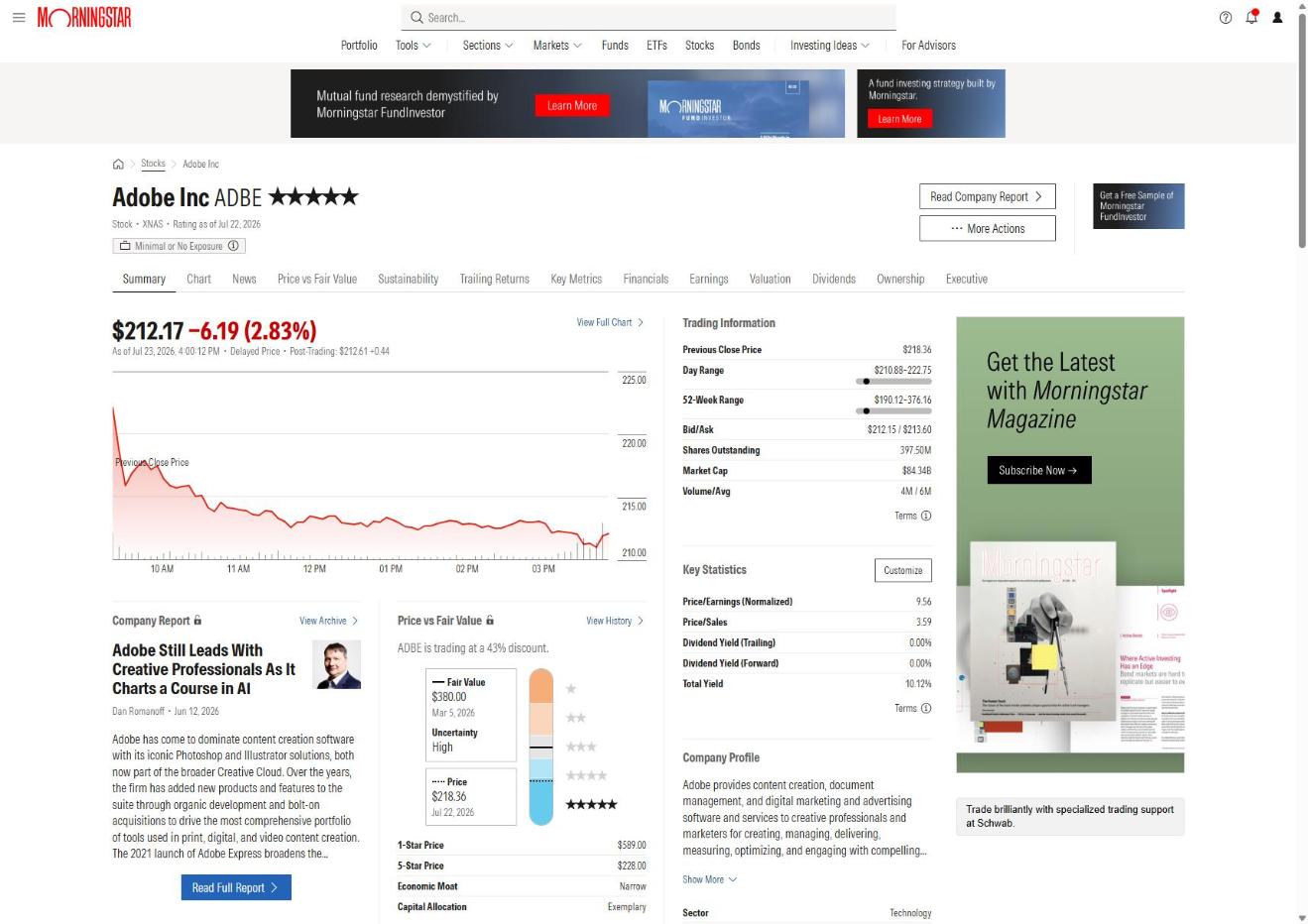
Written analyst research. Morningstar employs analysts who publish full reports on individual securities: a fair value estimate, an economic moat rating, and a view on where the price sits against what the business is worth. Free visitors see the rating. Subscribers see the reasoning behind it, which is what you want when you disagree with the rating.
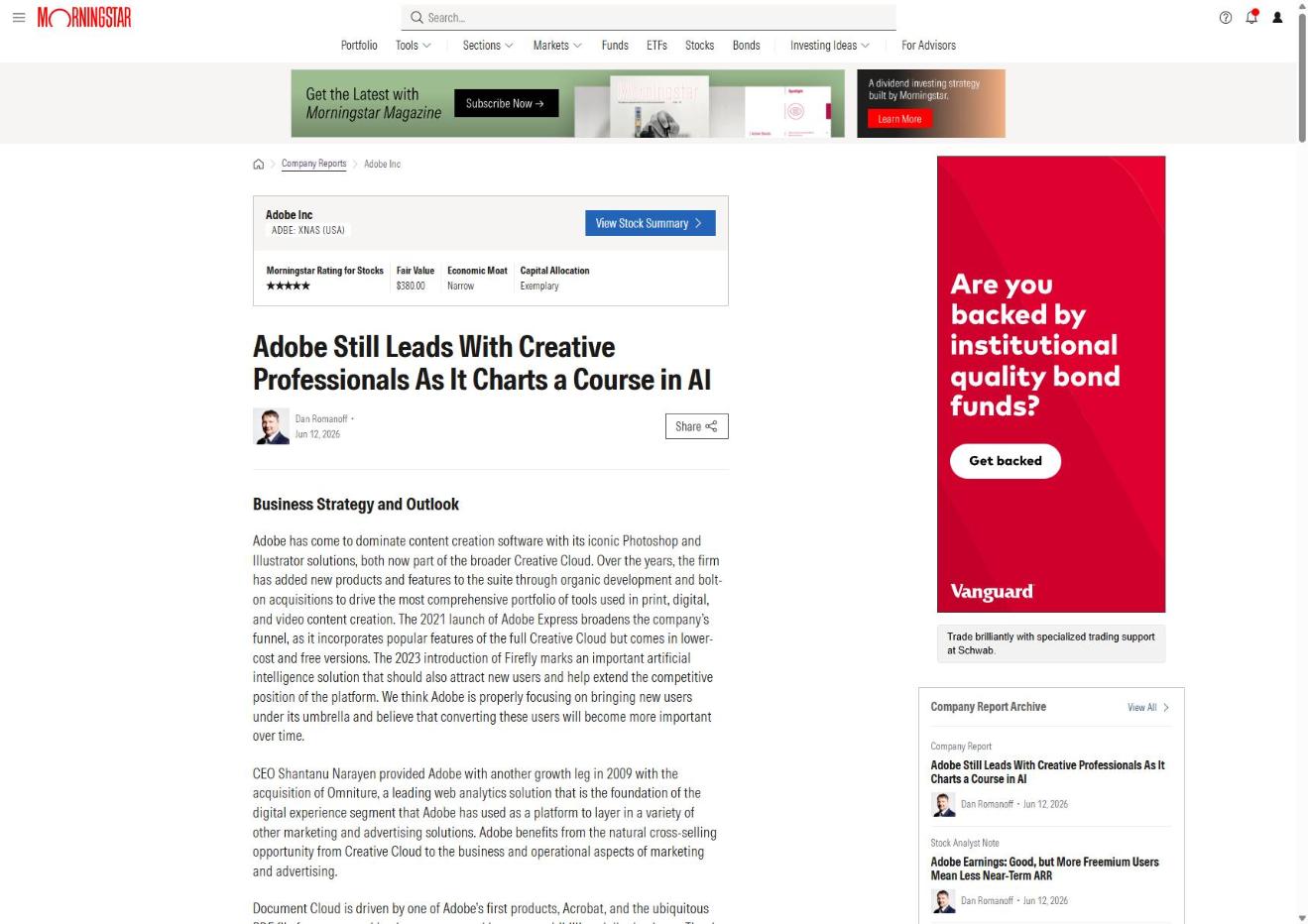
Portfolio X-Ray. You enter your holdings and it breaks them apart: asset allocation, sector and regional exposure, the fees you are paying in aggregate, and the stock overlap between funds you assumed were diversifying each other. Three index funds that all lean 30% into the same handful of megacaps? X-Ray shows you that in seconds.
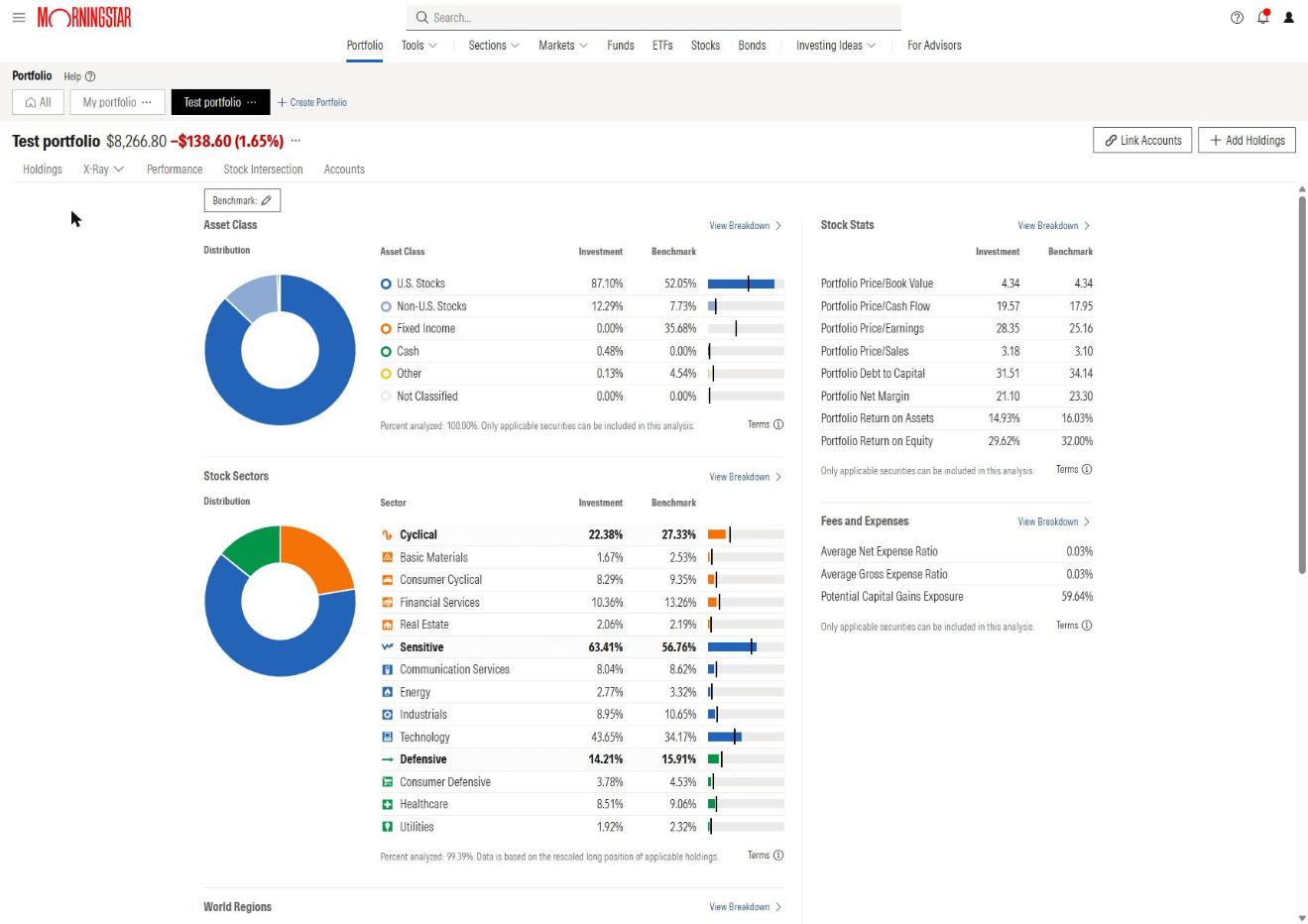
Screeners with the ratings attached. You get more than 200 data points, and you can sort and filter on Morningstar’s own ratings instead of just price and volume. Screening for wide-moat companies trading below fair value takes about two minutes.
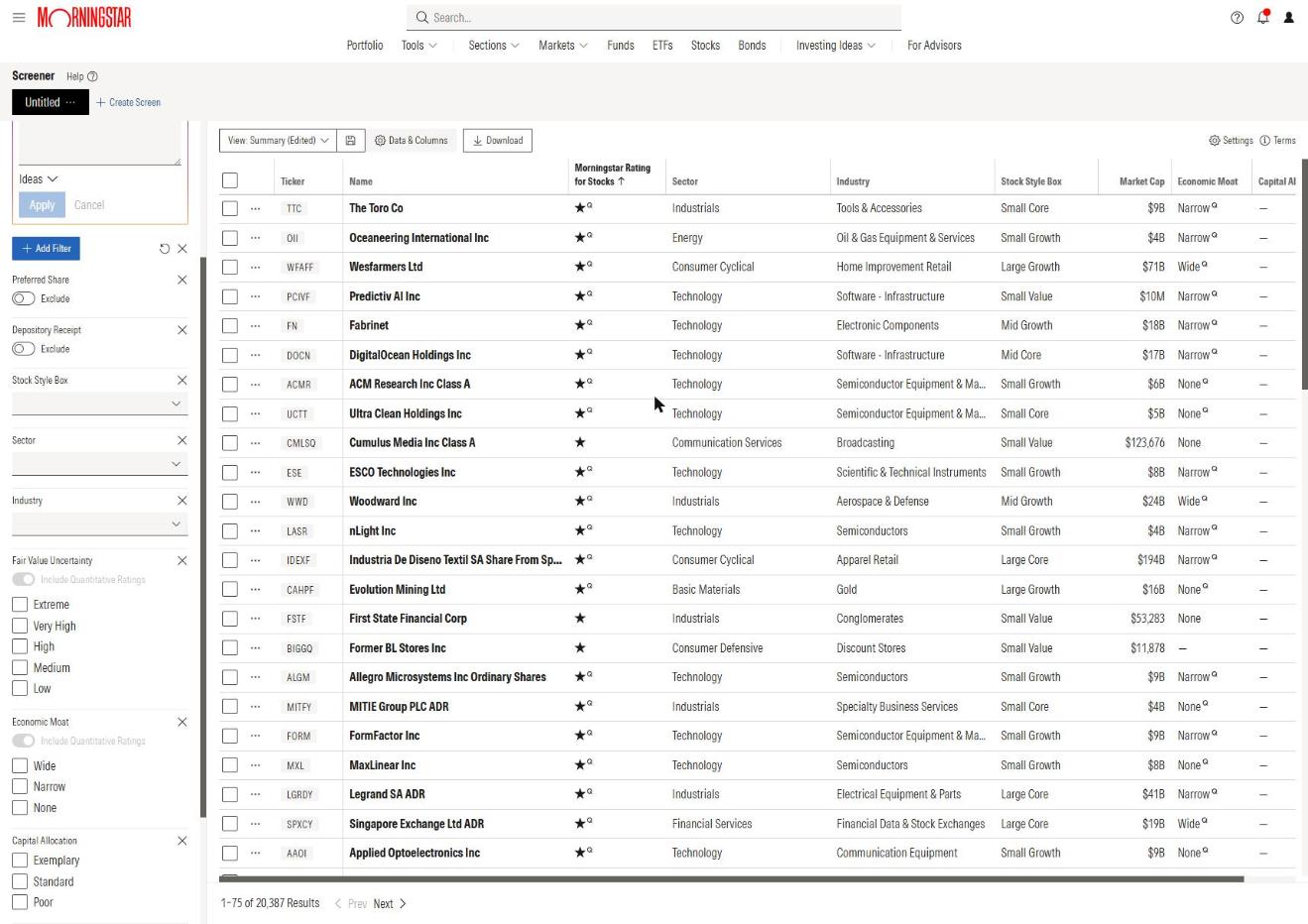
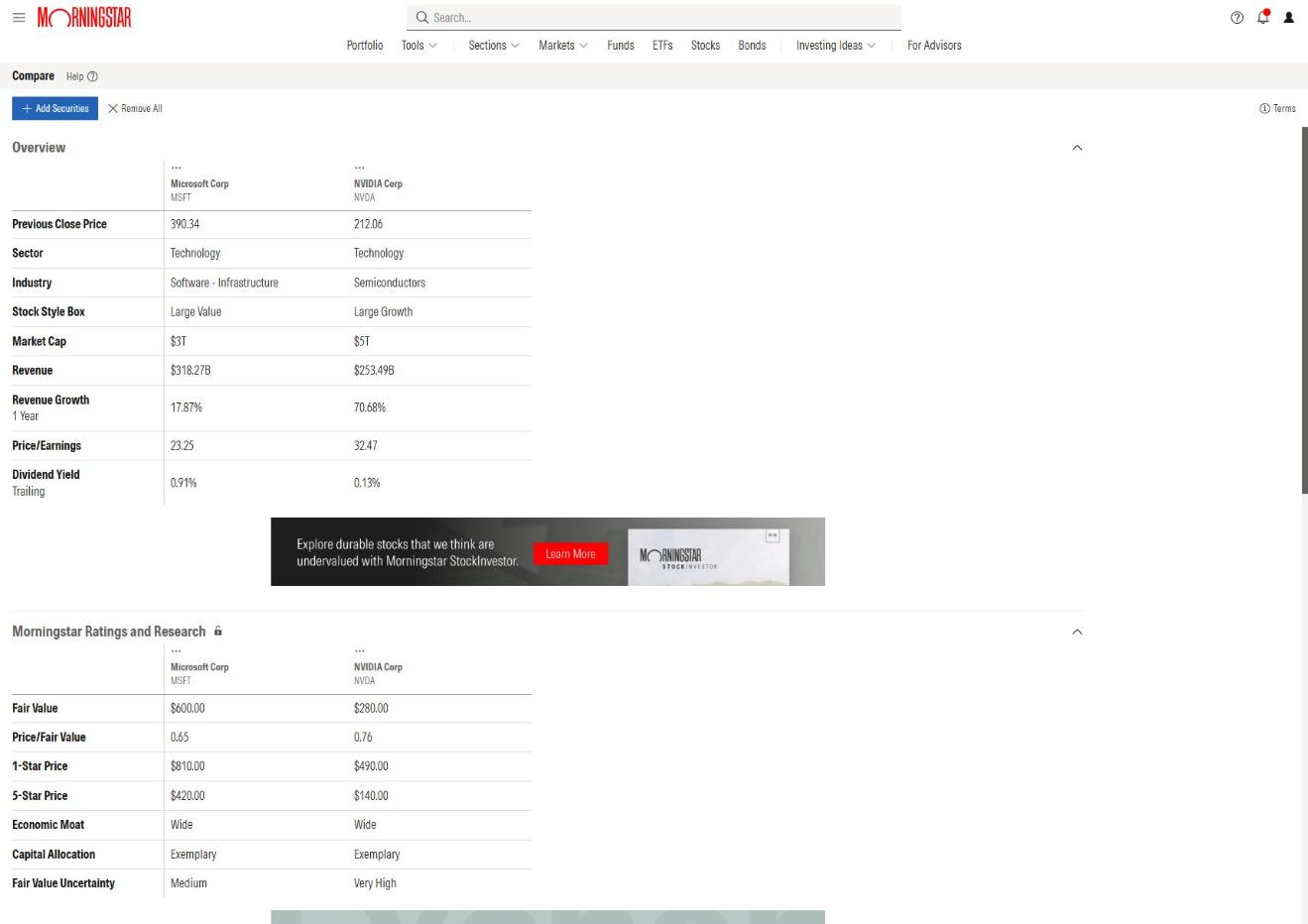
Comparison and monitoring. Side-by-side comparison of securities on the same metrics, custom views you can save, watchlists, and alerts when something changes on a holding: a ratings move, an analyst note, an earnings date.
The star ratings need one clarification. They are backward-looking and quantitative. They describe how a security is priced against Morningstar’s estimate of what it’s worth. They are not forecasts, they are not recommendations, and they are not investment advice. The analyst reports are opinions with reasoning attached, which is a more useful thing to have than a signal.
See Portfolio X-Ray on your own holdings, free for 7 days
How the Free Trial Works
Both plans open with a seven-day free trial. Morningstar says the trial ends at 11:59 PM CT seven days after it begins, and that if you have already taken a Morningstar Investor trial, you are not eligible for another one. So you get one shot at this. Don’t start it on a week you’re too busy to use it.
Seven days is plenty to load your actual portfolio into X-Ray and read what comes back. If the overlap and fee picture tells you something you did not already know, you have a reason to subscribe. If it just confirms what you assumed, you have your answer and it cost you nothing.
Student, Teacher and Military Pricing
Morningstar runs discounted rates for three groups. These come from Morningstar’s affiliate terms and not the public pricing page, which shows the standard offer by default. Treat them as accurate as of September 2026 and expect to verify your eligibility during sign-up.
| Who | Discount | First-year price |
|---|---|---|
| Students | 90% off | $25 |
| Teachers | 60% off | $99 |
| Military | $75 off, around 30% | $174 |
The student rate is the standout. At $25 for a year, Morningstar Investor costs less than a textbook and hands a finance student the same analyst reports a professional reads. If you’re eligible, this one barely needs thinking about.
Who Should Actually Pay for It
It comes down to how you invest. Here’s who gets their money back out of it:
- You hold individual stocks or several funds and you make your own calls. The break-even is not abstract. At $199, this pays for itself if it stops you making one badly diversified purchase, or if X-Ray shows you are paying an extra 0.4% in fund fees on a $50,000 portfolio.
- You’re mainly a fund investor. Fund research is the strongest thing Morningstar does, and there is no free equivalent with anything like the same depth.
- You qualify for the student rate. At $25, the question answers itself.
And here’s who should keep their money. If you hold two or three broad index funds and rebalance once a year, there’s nothing wrong with that portfolio. It just does not generate the kind of questions $199 of research answers. If you’re after stock picks, this isn’t that either. Morningstar tells you what it thinks a company is worth and why, then leaves the decision with you. That is the right behaviour from a research firm, but it’ll disappoint you if you came looking for a signal.
The tricky case is the trader who just wants ratings to screen with. That works, but you are buying a deep research library and using a slice of it. Check whether your broker’s own screener already does enough before you commit.
How to Pay Less Than $199
Three levers, in order of how much they are worth.
- Pay annually instead of monthly. That’s $220.40 back in year one, it’s the biggest single saving on the table, and it needs no code at all.
- Check whether you qualify for student, teacher or military pricing before you do anything else. At $25, $99 or $174, those rates beat any promotional code.
- Use a current offer code if you’re paying the standard rate. Morningstar’s discounts are conditional and they move around, so check what’s live before you sign up.
If you’re going to hunt for a code, do it now and not after you’ve subscribed. The first-year offer cannot be applied to an existing subscription, so a code you find a week too late is worth nothing to you. Our running list of what’s currently available is in Best Morningstar Discount Codes & Promo Offers, and we update it as offers change.
Get your first year of Morningstar Investor for $199
Our Take
$199 for the first year, $34.95 a month if you would rather not commit, $249 on renewal. Morningstar does not hide any of those numbers and we are not disputing them.
But the price is not really the decision here. The decision is whether your portfolio is complicated enough to have questions in it. If it is, X-Ray and the analyst library will turn up things you did not know about your own holdings, and $16.58 a month is not a serious sum against a portfolio worth analysing. If you own three index funds and a plan you already trust, this’ll be a good read and a recurring charge.
That’s exactly the question the seven-day trial exists to settle, and you can settle it with your own numbers instead of ours. Load the portfolio, read the X-Ray, then decide. Prices confirmed 14 September 2026 and subject to change.
Run your own portfolio through X-Ray before you pay anything
FAQs
Morningstar Investor is $34.95 a month, or $199 for your first year on the annual plan, down from a $249 list price. That annual rate works out to $16.58 a month. Both plans start with a seven-day free trial. Prices confirmed 14 September 2026 and subject to change.
Parts of it are. Quotes, basic fund and stock pages, market news and the star ratings themselves cost nothing. What the subscription adds is the written analyst research behind those ratings, Portfolio X-Ray, the full screeners and the comparison tools.
The $199 rate applies to the first year of an annual subscription only. Renewal is at the list price of $249 unless another offer applies at that time, so it’s safest to budget year two at $249.
Yes. Morningstar’s affiliate terms list a 90% student discount, bringing the first year to $25, plus 60% off for teachers and $75 off for military. These are not shown on the standard pricing page, so expect to verify eligibility during sign-up.
It depends on what you hold. If you run a portfolio of individual stocks or several funds and make your own decisions, X-Ray and the analyst reports earn their price by showing you overlap and fees you were not tracking. If you hold two or three broad index funds and rebalance annually, it’ll be interesting reading and not much more.