Seeking Alpha launched its Quant Growth & Income (QGI) model portfolio on June 3, 2026. Two months in, the portfolio has already drawn attention from dividend investors looking for a rules-based framework that pairs income with capital appreciation. This review breaks down how QGI works, what it costs, and whether it delivers on its promises.
Key Takeaways
Here is a summary of what this article covers and the conclusions it reaches:
QGI is a rules-based model portfolio that uses quant ratings and Dividend Grades to select up to 30 dividend-paying stocks. It is not a fund, ETF, or managed account; subscribers must execute trades themselves through their own brokerage account.
From its June 3, 2026 launch date through early August 2026, QGI’s model total return reached roughly 12.3%, compared to about 1.8% for its benchmark, Vanguard High Dividend Yield ETF (VYM). The average trailing yield of QGI is 2.64% as of August 2026.
Back-tested data from 2015 through 2025 showed QGI criteria turning $10,000 into approximately $60,191, versus roughly $30,000 for VYM over the same period.
The subscription cost runs in the mid-hundreds of dollars annually, making it most practical for investors with portfolios of $50,000 or more. Seeking Alpha offers discounts on subscription services occasionally, which can reduce first-year costs.
QGI has a short live track record since it began in June 2026, so investors should treat early results with appropriate caution.
About Seeking Alpha
Seeking Alpha, founded around 2004, operates as an investment research platform and the world’s largest investing community for active investors. The platform has over 20 million active users and features over 7,000 verified authors who post in depth analysis across US stocks, ETFs, REITs, and ADRs.
The platform provides thousands of daily research reports, earnings call transcripts, and crowd-sourced analysis alongside its proprietary quantitative tools. These tools include quant ratings, factor grades, Dividend Grades, screeners, and portfolio alerts. Seeking Alpha is not a broker or asset manager. It provides research, insights, and model portfolios that investors use to make informed investment decisions inside their own accounts.
Seeking Alpha has become known for its quant-driven approaches to stock selection, which power three model portfolios: QGI, Alpha Picks, and PRO. The quant growth, value, and income frameworks behind these products form the backbone of the platform’s data-driven stock analysis.
What Is Seeking Alpha Quant Growth & Income (QGI)?
QGI is a rules-based model portfolio on Seeking Alpha that aims for long-term capital appreciation and consistent dividends through a combination of quant ratings and dividend factor grades. It holds up to 30 dividend-paying stocks, including US-listed equities, ADRs, and REITs, all of which must be paying dividends to qualify.
QGI is not a real-money portfolio and does not auto-trade funds. There is no bot executing orders on your behalf. Subscribers view the published holdings, then place their own trades through whatever broker they use. The portfolio aims to outperform high-dividend benchmarks like the Vanguard High Dividend Yield ETF (VYM) while maintaining competitive yield and stronger quality metrics.
QGI is positioned as Seeking Alpha’s dedicated growth and income model, distinct from Alpha Picks (pure capital appreciation, no dividend requirement) and PRO (higher turnover, weekly updates). If you want structured dividend investing with a quant growth tilt, QGI is the product Seeking Alpha designed for that purpose.

How Quant Growth & Income Selects and Removes Stocks
QGI’s selection engine starts with Seeking Alpha’s Quant Ratings and layers on Dividend Grades to filter for income quality. Candidate companies must hold at least a Buy or Strong Buy Quant Rating for a sustained period before they qualify, ensuring the quant growth and quality signals are not fleeting.
Seeking Alpha offers Dividend Grades for income-focused investors, and these grades assess safety, growth, yield, and consistency. QGI requires holdings to meet minimum thresholds on Dividend Safety and Dividend Growth grades. Stocks with deteriorating payout ratios, cash flow problems, or analyst warnings about dividend cuts are filtered out or flagged for removal.
Removals are typically triggered by three events:
A stock’s Quant Rating drops below the Buy threshold
Dividend metrics deteriorate (cuts, suspensions, or unsafe payout ratios)
A better-scoring candidate emerges in the filtered universe, creating a swap opportunity
QGI rebalances every two weeks, ensuring timely adjustments. This biweekly cadence sets it apart from weekly or daily quant strategies, making it less demanding on subscribers who prefer fewer trades.
How the Quant Growth & Income Portfolio Works in Practice
QGI is a manual model. Seeking Alpha publishes the portfolio’s trades and allocations; subscribers must decide position sizing, execution timing, and tax handling themselves. There is no automatic execution or managed account integration.
The published performance assumes trades occur at opening prices on pick dates and closing prices on sell dates, with dividends reinvested. QGI’s performance is calculated using notionally calculated returns and reinvested dividends, verified by a third party (S&P Global). Real investors will face slippage, bid-ask spreads, and partial fills. Investors may experience transaction friction due to the bi-weekly rebalancing schedule, particularly in less liquid ADRs or smaller-cap holdings.
Practical considerations for subscribers:
Positions are limited to roughly 30 holdings with approximate equal weighting
Some brokers may not support fractional shares or certain ADR tickers
In taxable accounts, each sell triggers capital gains calculations
Some brokers still charge commissions on certain trades; confirm your fee structure before mirroring positions
A new subscriber joining in September 2026 would typically phase into existing holdings at current market prices, then follow biweekly updates going forward. There is no need to press hold to confirm every trade simultaneously; phasing in over a few days can reduce market impact.
What Subscribers Get with Quant Growth & Income
The QGI dashboard provides a clean table of current holdings with tickers, target weights, forward and trailing yields, quant ratings, and Dividend Grades. A chart comparing QGI’s performance against VYM updates with each rebalance cycle, giving subscribers a transparent line of sight into how the portfolio stacks up.
The analysis section includes biweekly written trade notes that explain the rationale behind each addition, trim, or sell. These notes reference specific changes in quant and dividend grade scores, offering in depth analysis of why a stock entered or exited the portfolio. Subscribers also get alerts when new trade updates are published.
Additionally, the portfolio history tab logs every change since the June 2026 launch, so new subscribers can review past decisions and understand how the strategy evolved. Seeking Alpha also hosts recorded webinars and Q&A sessions with the quant team, covering recent rebalance decisions, sector rotations, and macro context for dividend investing. Subscribers get unlimited access to these resources alongside their QGI membership, including earnings call transcripts for all held companies.
Early Performance: Growth & Income vs. Vanguard High Dividend Yield (VYM)
QGI launched on June 3, 2026, so its live track record spans just two months as of this review. Early results are promising but must be read in context.
Metric | QGI (Model) | VYM |
|---|---|---|
Total Return (June 3 – Aug 2, 2026) | ~12.3% | ~1.8% |
Forward Yield | ~2.8% | ~2.26% |
Trailing Yield | 2.64% | ~2.26% |
Yield on Cost | >3.0% | ~2.26% |
QGI also outperformed the S&P 500 by roughly 10.96% during this initial window. Three sample QGI stocks averaged a 3.56% dividend yield versus 2.26% for VYM and 1.01% for SPY, according to Seeking Alpha’s own performance reporting.
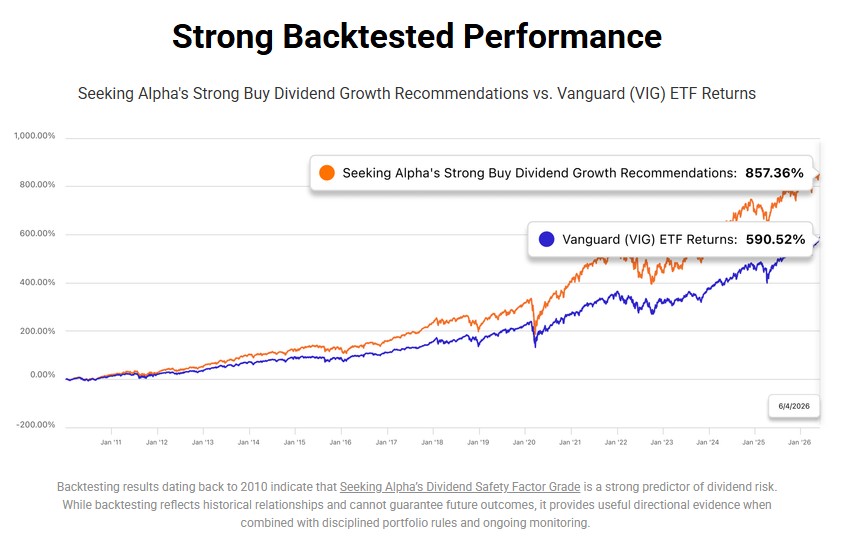
Two months of data does not establish a reliable pattern. In back-tests covering 2011 through early 2026, QGI criteria outperformed Vanguard’ VIG fund 857% to 590%. There is no guarantee this will continue but it looks promising. And based on other success Seeking Alpha has had with its Quant model, I see no reason why this service would be any different.
Whether the live portfolio can sustain its early momentum through a market correction or rate-driven volatility remains an open question. Performance data before June 2026 is back-tested, not live, and long term returns will depend on how the model handles real market stress.
Seeking Alpha’s Quant Ratings
Quant ratings are Seeking Alpha’s flagship scoring system. They rank stocks from Strong Sell (1.0) to Strong Buy (5.0) based on five key metrics: value, growth, profitability, momentum, and EPS revisions. Each factor grade compares a stock against sector peers, and quant ratings score over 10,000 stocks as Strong Buy to Strong Sell across the US-listed universe.
A 2024 study found quant ratings strongly predict future returns. Strong Buy stocks have outperformed the S&P 500 since 2010, while Strong Sell ratings have consistently lagged. Quant ratings are updated using real-time market data, giving QGI a dynamic, data-driven edge compared with static dividend screens that only refresh quarterly.
For QGI, quant ratings serve as the first filter: only stocks rated Buy or Strong Buy qualify. If a holding’s rating drops, it triggers a review and potential removal. Investors who subscribe only to premium can still access quant ratings and build their own portfolios, but QGI offers a pre-built structure for those who want curated guidance without creating a screening process from scratch.
How Much Does It Cost?
Seeking Alpha Premium costs $239 annually after the trial period and includes access to quant ratings, Dividend Grades, screeners, and analyst reports. QGI is a separate, higher-tier subscription. Public offers around mid-2026 have placed QGI annual pricing at approximately $449 per year through some affiliate promotions, though list prices vary by campaign.
For context, here is how subscription cost scales against portfolio size:
Portfolio Size | QGI Cost (~$449/yr) as % of Assets |
|---|---|
$25,000 | 1.80% |
$50,000 | 0.90% |
$100,000 | 0.45% |
$200,000 | 0.22% |
The subscription cost is relatively significant for smaller portfolios. Membership requires a subscription which must be justified by performance, so investors with portfolios under $25,000 may find passive ETFs like VYM more cost-effective. QGI access does not automatically bundle Alpha Picks or PRO. Check the current pricing page for up-to-date numbers, since promotions and trial terms can change.
Where to Get the Best Seeking Alpha Discounts?
Many investors look for ways to reduce the cost of subscribing to QGI, Alpha Picks, or premium before committing to a full year. Seeking Alpha runs seasonal promotions where portfolio products may be discounted by 20 to 30% off list price for a limited time.
Strategies for finding the best deals:
Seeking Alpha Premium includes a 7-day free trial, letting you explore quant ratings and Dividend Grades before paying
Watch official Seeking Alpha email newsletters and homepage banners for seasonal sales (summer, Black Friday, end-of-year)
Partner sites and affiliate links sometimes offer coupon codes with savings that can reach $100 to $150 on annual plans
Bundle offers (e.g., Premium plus Alpha Picks) have historically saved subscribers money versus buying each product separately
Avoid unofficial coupon aggregators that may post outdated or misleading codes. Starting during a sale period is a practical way to test whether QGI fits your investing style before committing at full price.
Quant Growth & Income vs. Alpha Picks vs. PRO
Seeking Alpha offers three model portfolios, each designed for a different type of investor.
Feature | QGI | Alpha Picks | PRO Quant |
|---|---|---|---|
Holdings | Up to 30 | 2 new picks/month | ~30 stocks |
Update Frequency | Every 2 wee ks | Monthly | Weekly (2-3 changes) |
Dividend Required? | Yes | No | No |
Benchmark | VYM | S&P 500 | S&P 500 |
Turnover | Moderate | Low | Higher |
Best For | Dividend + growth investors | Long-term growth stock pickers | Active quant traders |
Alpha Picks provides two new stock ideas each month, targeting capital appreciation without requiring dividends. The PRO Quant Portfolio updates weekly with two to three changes, designed for more active investors willing to tolerate higher turnover. QGI sits in between: moderate rebalance cadence, mandatory dividends, and exposure to both income and quant growth signals.
Is Quant Growth & Income Worth It; And Who Is It Best For?
QGI’s early outperformance and structured methodology are promising, but a two-month live track record does not prove lasting alpha. Investors should weigh cost, effort, and risk before subscribing.
Advantages:
Rules-based, transparent selection with published rationale for every trade
Integration of quant ratings with dividend safety and growth filters
Manageable biweekly rebalance cadence for investors who want fewer decisions
Investors can combine it with broader strategies for better portfolio balance
Limitations:
No automatic execution; tracking error is inevitable for subscribers
The portfolio’s concentration strategy (30 stocks) can lead to increased portfolio-specific risk
Back-tested performance is not the same as live results
Annual cost makes less sense for portfolios under $50,000
The portfolio is designed for self-directed investors who prefer a systematic investing approach. The ideal user has at least a mid-five-figure portfolio, wants disciplined dividend income with growth potential, and is comfortable placing trades twice a month. Professionals or retirees managing their own money in tax-advantaged accounts may find the combination of dividend safety screening and quant growth selection a successful framework.
If you already use Seeking Alpha’s tools and trust the quant ratings methodology, QGI adds a pre-built income layer that saves research time. For income investors who want confidence in their stock selection process, QGI earns a conditional positive recommendation; conditional on the live track record continuing to align with its back-tested results over the coming quarters.

FAQs
Do I need a separate Seeking Alpha Premium subscription to use Quant Growth & Income?
QGI is a distinct subscription from basic Seeking Alpha Premium, with its own pricing and sign-up flow. While QGI subscribers can see all portfolio holdings and related analysis, having premium alongside QGI is helpful for exploring quant ratings and Dividend Grades on stocks outside the official portfolio. Check the current product page for any bundled promotions that may combine both at a lower total cost.
Can I customize the Quant Growth & Income portfolio to fit my risk level?
Subscribers are free to adjust position sizes, omit specific stocks, or cap sector exposure when mirroring QGI. Doing so will create tracking error versus the model performance. Practical risk-control tactics include starting with half-sized positions, phasing into new additions over multiple days, or skipping holdings that conflict with personal screens. Seeking Alpha does not manage money or provide personalized advice, so customization decisions rest with you.
How does Quant Growth & Income handle dividend cuts or suspensions?
The model continuously monitors dividend metrics and quant ratings. Dividend cuts, suspensions, or sharp downgrades in Dividend Safety grades typically trigger a review and potential removal at the next biweekly update. Trade notes in the analysis section explain when a stock is being sold because of deteriorating dividend quality. Investors should still verify company-specific news in earnings releases and press coverage before executing any sell decisions, addressing any concerns before they become losses.
Is Quant Growth & Income suitable for retirement accounts?
Many investors use dividend strategies like QGI inside tax-advantaged accounts (IRAs, 401(k)s) to shelter rebalancing gains and dividend income from immediate taxation. Suitability depends on your brokerage access, local tax rules, and whether the account allows trading in all QGI holdings, including some ADRs and REITs. Consult a tax or financial professional for personalized guidance on using quant growth and dividend portfolios inside retirement vehicles.
What happens if I stop subscribing to Quant Growth & Income?
If your subscription lapses, you keep all existing holdings in your brokerage account but lose access to future trade updates, analysis notes, and the performance dashboard. Some investors hold their last replicated portfolio as a static dividend basket, while others transition to passive ETFs like VYM. Before subscribing, consider how dependent you want to be on QGI’s signals, especially if you prefer low-maintenance, long-term holdings. Community feedback suggests that having a fallback plan before joining makes the transition smoother if you later decide to cancel.