Seeking Alpha and Yahoo Finance are two of the many online investment research platforms available. As you might expect, they have some things in common and offer some similar features.
The real question is: which platform is best for investors who want to make data-driven decisions about which stocks to buy and get a handle on whether they should sell or hold existing investments.
Here’s a quick overview comparing the key features of each platform to give you an idea of what to expect in this Seeking Alpha vs Yahoo Finance review.
Seeking Alpha
Yahoo Finance
Quant Ratings
Broad market overview
Detailed stock analysis
Simple user interface
10 years of financials for most stocks
Daily stock recommendations
High-growth stock recommendations
Cryptocurrency analysis
Advanced stock and ETF screeners
Comparing these two platforms to one another is essential for any investor who wants to make data-driven decisions about investing. Keep reading our Seeking Alpha vs Yahoo Finance review to get a detailed comparison of features and costs, plus our analysis of which platform is better for investors.
As you evaluate investment research platforms, keep in mind that neither Seeking Alpha nor Yahoo Finance is regulated by FINRA.
Features Breakdown: Seeking Alpha vs Yahoo Finance
The only way to get a handle on which stock research platform is best for you and your investing strategy is to do a direct comparison of features.
Here’s our take on Yahoo Finance vs Seeking Alpha features – and make sure to check out our Seeking Alpha review. Keep in mind that neither service is a brokerage, so they aren’t regulated by FINRA.
Seeking Alpha Quant Ratings
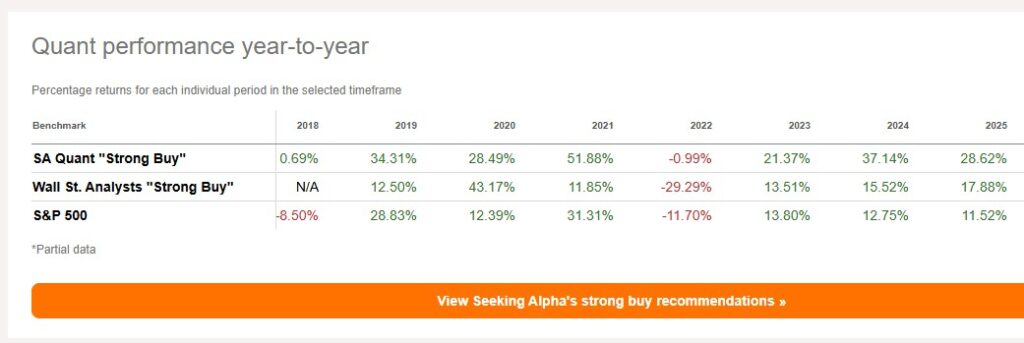
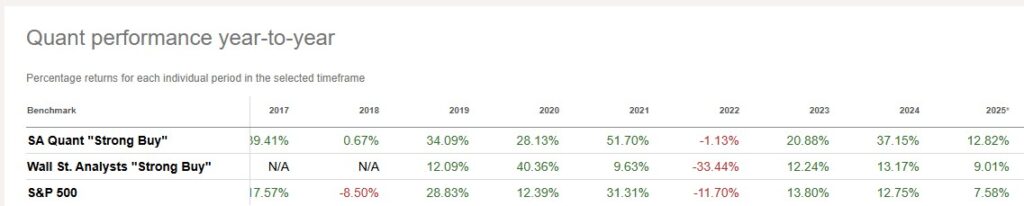
Seeking Alpha’s Quant Ratings are their “secret sauce” and why it is worth subscribing to Seeking Alpha Premium. Take a look at this chart of the historical performance of their Quant Rating “Strong Buy” versus the market. This should convince you to make sure you have lots of “Strong Buys” in your portfolio. Conversely, stocks rated “Strong SELL” have consistently UNDER-performed the market; so make sure you DO NOT have any STRONG SELLS in your portfolio.
So, why should you care about the Quant Ratings?
As you can see above, the Strong Buys outperform both Wall Street Analysts and the S&P500 every year going back to 2010.
Seeking Alpha’s Quant Ratings are widely respected among investment professionals. Using more than 100 metrics, Seeking Alpha evaluates stocks and assigns a rating between 1 and 5. A rating of 1 indicates a Strong Sell, while a 5 indicates a Strong Buy recommendation.
Seeking Alpha Premium
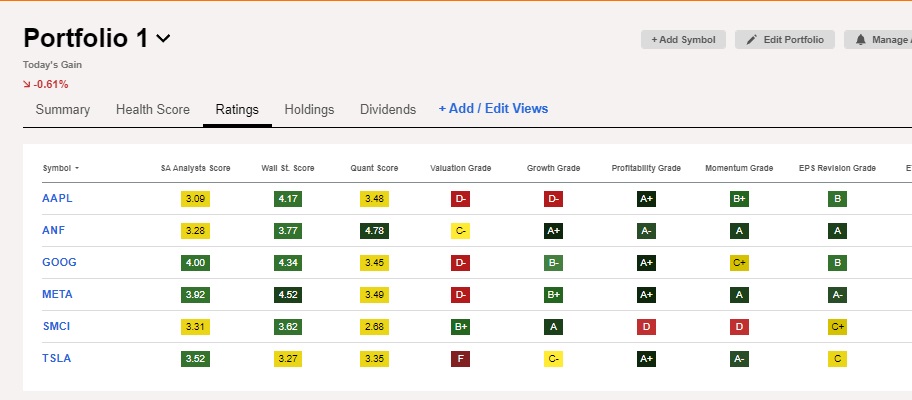
If you subscribe to Seeking Alpha Premium, you can connect your brokerage account so you can get their Quant Ratings on all of your stocks, as you can see above, and get a quick snapshot of your overall portfolio as you can see below…
Yahoo Finance doesn’t have anything that’s equivalent to the Quant Rating. The closest thing they provide is access to Morningstar Ratings, which are included in the Silver and Gold plans. There’s information there, but you’ll need to make your own evaluations of what it all means.
There’s a competitive advantage to using Quant Ratings, since Seeking Alpha’s “Strong Buy” selections have outperformed the S&P 500 consistently.
If you are just looking for quality stock picks each month, then you should consider Seeking Alpha’s Alpha Picks which gives you their 2 top Quant Rated picks each month. This service costs $499 a year, but it is clearly worth it.
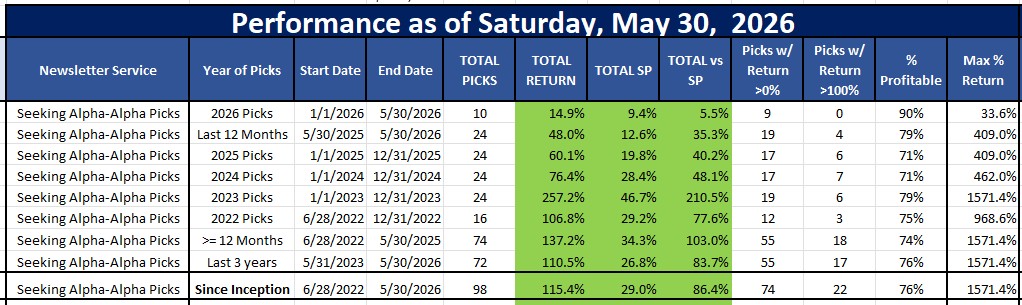
Take a look at the performance of Alpha Picks for the last few years.
Here's a summary of Alpha Picks' performance for each year since inception as of May 31, 2026 to give you an idea if it is worth it.
While the markets have recovered from the Iran war and continue to set records, so too have Alpha Picks as they continue to easily beat the market's performance. My analysis speaks for itself on the value of their Alpha Picks service. These returns prove it has been providing huge gains over the S&P since its launch with a lifetime BEAT of the S&P of all their picks of 83.7%. Some might think it is a little pricey at $499 a year, but think of it this way. If you have at least $10,000 in the market and you can improve your return by 5% a year then it pays for itself ($10,000 x 5% = $500). Obviously if you have more than $10,000 in the market then it is a no-brainer. Look at this chart and it will convince you that you need Seeking Alpha. Like I said, I have been a subscriber since 2022.
That’s quite impressive as every year since inception in 2022 they have easily outperformed the market. Most experts on Wall Street can’t do that. So, as you can tell, I am a big fan of Alpha Picks since I have strong evidence that their Quant Rating works.
So how does Seeking Alpha stock picks stack up against the competition?
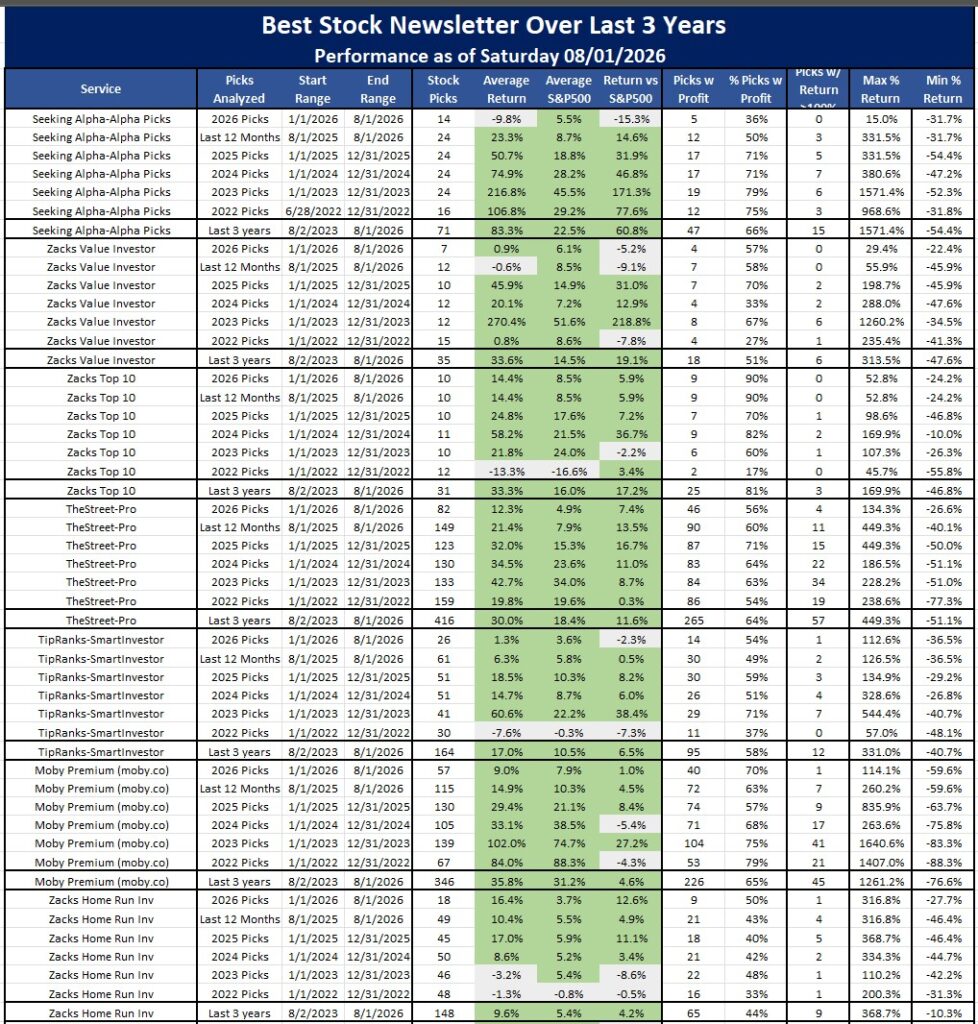
Here is my analysis as of December 27, 2025 summarizing the best stock newsletters over the last 3 years. These are ranked by Return vs S&P500 on the average of their last 3 years of picks.
Wow! Alpha Picks is beating all of the other services that I subscribe to, and by a wide margin for 3 years running.
Best Discounts for September, 2026:
Seeking Alpha has become so successful in the last few years that they rarely discount their services. But they currently are running a 10% Summer Sale on the promo pages below (sale ends at the end of this month). This is one of their biggest discount of the year so far. Here's your chance to get a free trial, save 10% AND get their next stock pick in real-time:
Both Seeking Alpha Premium and the Yahoo Finance Silver and Gold plans offer stock analysis to users. Seeking Alpha’s analysis includes Quant Ratings, news, and user-created content. The community aspect of Seeking Alpha is something that’s notable and unique. Our only caveat here would be that it’s important to verify information from user content since Seeking Alpha doesn’t vet it.
Yahoo Finance offers access to research reports and personalized investment ideas, but they’re only available with the Silver and Gold plans.
Advanced Tools and Screeners
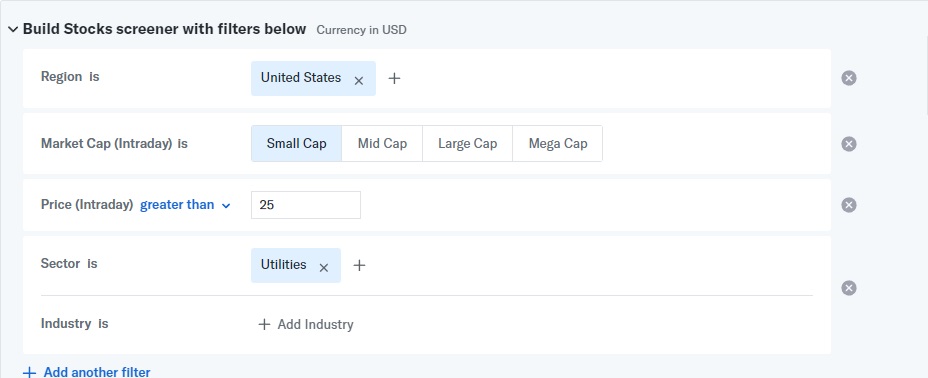
Both Seeking Alpha and Yahoo Finance offer users the option to create stock screeners to help them make investment decisions. Seeking Alpha has advanced screeners with hundreds of options to get the exact data you need.
By contrast, Yahoo Finance’s screeners are much simpler and offer fewer filtering options.
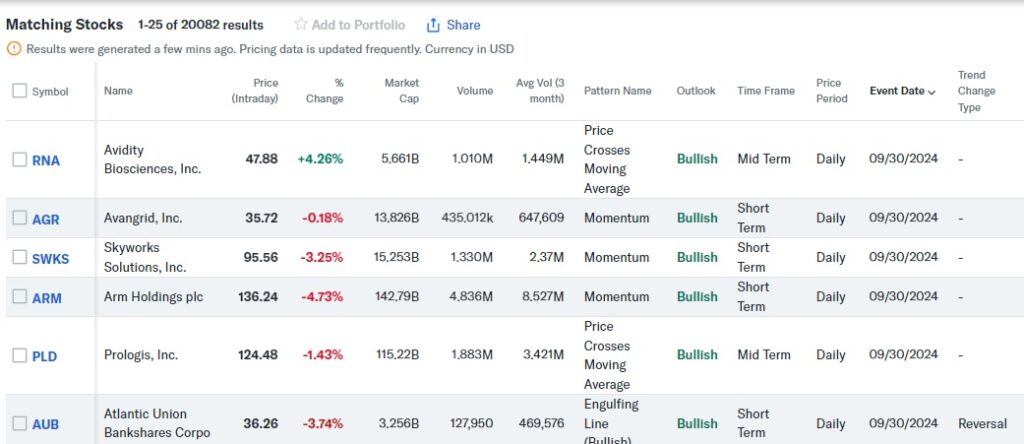
There are also some pre-set screeners on Yahoo Finance, like this one that filters out stocks that Yahoo Finance has labeled as Bullish.
Seeking Alpha’s advanced filters are ideal for more experienced investors or those who are willing to explore the filters and learn how they can help them choose investments.
Financial data is undeniably valuable when selecting investments. Seeking Alpha offers 10 years of financials for every stock, something that makes it easy to see any company’s history and performance, including financial statements, earnings call summaries, and much more.
Yahoo Finance has more limited data sets in some circumstances. Subscribers to the Gold Plan get access to historical data that includes income statements and balance sheets.
Portfolio Management Tools
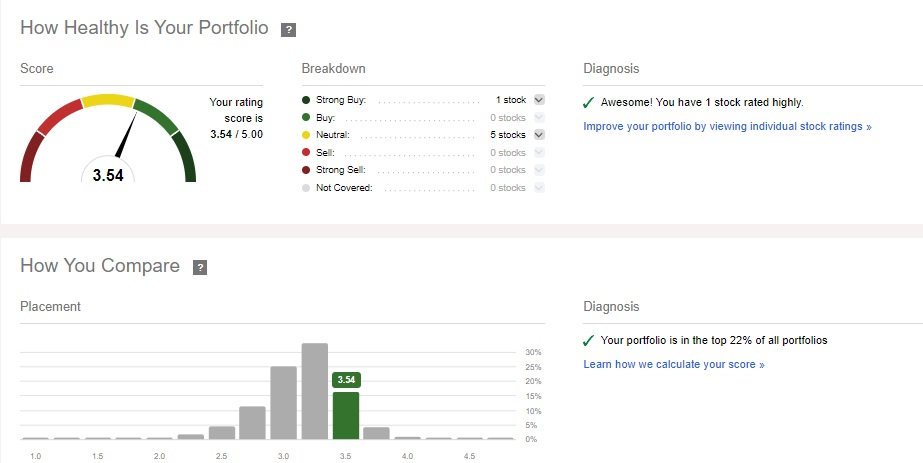
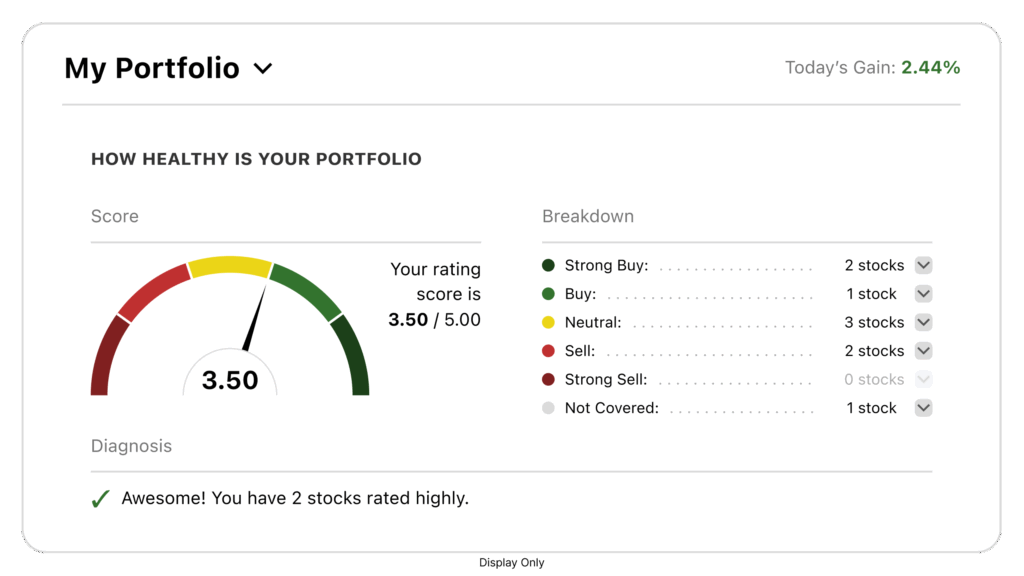
Both Seeking Alpha and Yahoo Finance offer subscribers access to portfolio management tools. Where Seeking Alpha stands apart is its Portfolio Health Score. The health score offers a snapshot of any portfolio’s stability and potential performance.
As you can see, this portfolio has mostly neutral investments and has received a health score of 3.54, which puts it in the top 22% of all portfolios on Seeking Alpha. Yahoo Finance does not have an equivalent to the portfolio health score, although they do offer limited portfolio analysis.
On a related note, Seeking Alpha offers users dozens of customization options for viewing a portfolio. If you’re someone who wants to get a handle on historical stock performance, dividends, or any other factor, you can revise your view to make it exactly what you need it to be.
One of the areas where Seeking Alpha and Yahoo Finance are similar is that both offer stock alerts and notifications to all users. They’re easy to set up and can help you stay on top of news, price changes, and more.
Cost Comparison: Seeking Alpha vs Yahoo Finance
One of the most important questions to ask before subscribing to any investment research service is how much the service costs. You’ll also want to know whether there’s a free trial and how the annual subscription is billed.
Let’s start with Seeking Alpha. There’s a free version that provides the option to link to a portfolio, set up alerts, and read one Premium article per month. Seeking Alpha Premium comes with a one-month trial for just $4.99. After that, the annual cost is $299 for new subscribers and $499 at renewal.
The Premium version comes with unlimited access to expert analysis, Quant ratings, in-depth analytics and financials, and membership in the Seeking Alpha community.
The Bronze membership costs $95 per year and is best for monitoring your portfolio and is, according to Yahoo, ideal for tracking 401(k) or IRA portfolios. The Silver membership costs $239.40 per year and is designed for investors who want to learn investment basics but aren’t interested in active trading. Finally, the Gold membership costs $479.40 per year and is best suited for experienced investors who want to actively manage their portfolios.
Here’s a comparison chart that lays it all out for you.
Account
Price
Free Trial
Best For
Seeking Alpha Free
Free
N/A
Beginners who want to get their feet wet
Seeking Alpha Premium
$299/year for first-time subscribers; $499 for renewal
No, but there is a one-month trial for just $4.99
Intermediate to advanced investors who want a ton of data to help them choose investments.
Yahoo Finance Free
Free
N/A
Beginners who want an easy way to access investment news
Yahoo Finance Bronze
$95 per year
No
Novices who want an easy way to track 401(k) or IRA portfolios
Yahoo Finance Silver
$239.40/year
No
Beginners who want to learn the basics but aren’t interested in active trading
Yahoo Finance Gold
$479.40
No
Advanced investors who want a hands-on approach and are interested in active trading.
Seeking Alpha Paid Services Summary
Here’s a quick comparison of the major characteristics of the two services and their bundle:
Seeking Alpha Premium
Alpha Picks
Seeking Alpha Bundle
Overall Rating:
⭐⭐⭐⭐⭐
⭐⭐⭐⭐⭐
⭐⭐⭐⭐⭐
Service Type & Strengths:
Full access to all their research; link your brokerage account to get Quant Ratings on your stocks and alerts of when to sell.
2 stock picks a month that have their highest Quant Rating and most likely to outperform the market.
Includes both services
Strengths:
Strong Buy Quant Rating stocks have 5x the market since 2010. Quant Rating now verified by academic study. 250,000+ Premium members.
Beating the market by 40% in just 2 years; 9 picks have already doubled; over 76% of picks are profitable.
Get both to monitor your portfolio & get the best picks to buy.
Best for:
Self-directed investors who want to easily optimize their portfolio’s return.
Investors looking for specific stock recommendations each month
Both
Retail Cost:
$299 a year
$499 a year
$798 a year
Current Promotion:
September, 2026 Sale: Save Save $30 and get 7-day free trial.
September, 2026 Sale: Save Save $50 & get access to all their recent stock picks
September, 2026 Sale: Save $159 when you get both.
I subscribe to both of these Seeking Alpha services, and many more from other stock services. I don’t plan on canceling either of my Seeking Alpha’s subscriptions any time soon. For me, both Seeking Alpha Premium and Alpha Picks are absolutely worth the membership fee. To compare the two services, check out our Seeking Alpha Picks vs Premium article.
Importance of Using Seeking Alpha over Yahoo Finance
We think that Seeking Alpha is superior to Yahoo Finance and is a better option for many investors.
Here are some takeaways to help you decide which platform might be best for you.
Seeking Alpha offers more data and more features with its premium plan. If you’re an intermediate or advanced investor, then Seeking Alpha is likely the best choice for you.
Yahoo Finance has fewer advanced features and may be more accessible for beginner investors. That said, we should note that beginners who learn and want to grow may find themselves wishing for the more advanced features of Seeking Alpha.
Long-term traders may find more value from Seeking Alpha, while short-term and active traders may prefer Yahoo Finance’s news-based approach.
Both services offer a free plan with limited features.
On the whole, we think intermediate and advanced investors will benefit more from Seeking Alpha.
Imagine if you could plug your entire portfolio into a data-driven tool that flags buys and warns you when to sell.
One of Seeking Alpha's most powerful features is their Quant Rating on each stock. This system grades every stock daily using over 100 fundamental and technical metrics. Since 2017, the “Strong Buy” stocks have consistently outperformed both Wall Street analysts and the overall market. Just look at 2024: Quant Strong Buys gained 37.15%, compared to just 12.75% for the S&P 500:
The Quant Rating is an incredible stock screener on its own, but the real game-changer is pairing it with the My Portfolio tool.
Using Seeking Alpha Premium, I connect my brokerage accounts and track Quant Ratings across my entire portfolio in one simple dashboard. That means I get instant alerts when any of my holdings drop to a “Sell” or “Strong Sell.” I personally use it to know when it’s time to take profits—or tighten stop-losses—before a stock turns into dead weight.
It looks like this:
The combination of proven outperforming stock picks and personalized portfolio monitoring is why so many investors swear by Seeking Alpha Premium.
We’re comparing Yahoo Finance vs Seeking Alpha, but we think it’s important to seek outside perspectives. Here’s a quick overview of how real users have experienced each service.
On Capterra, Seeking Alpha users have awarded the service 4.3 out of 5 stars and praise the platform’s detailed analysis and metrics, useful articles, and unique perspectives. The most common complaints were laggy customer service response times, automatic renewals, and unvetted user content.
Trustpilot reviewers are close, giving Seeking Alpha 4.0 out of 5 stars. They praise “Strong Buy” stocks’ performance against benchmarks, plus detailed analysis, customer service, and dividend tracking. The most common complaints had to do with unvetted content and Seeking Alpha’s tendency to switch up what’s included with the Premium plan.
There are fewer reviews for Yahoo Finance. Apple users have given the Yahoo Finance app 4.7 out of 5 stars. Users praise many of the features, but also complain about technical issues and discrepancies, with one of the most worrisome complaints being a lack of synchronization between the app and users’ portfolios.
Conclusion: Which Platform Is Best for You?
Both Seeking Alpha and Yahoo Finance offer features to help investors research stock and make investment decisions.
The biggest strengths of Seeking Alpha are its Quant Ratings and detailed analysis, while Yahoo Finance offers a slightly more user-friendly interface.
Based on our experience and analysis, Seeking Alpha is the better of the two platforms. It’s ideally suited for intermediate and advanced investors, and for anybody who wants to dive into the numbers and read detailed analysis before making choices about what to buy or sell.
Yahoo Finance offers an interface that may be less confusing for beginners, and people who aren’t experienced may find the limited filters a good introduction to investing basics.
Those who are investing in crypto are likely to prefer Yahoo Finance because it offers cryptocurrency analysis, while Seeking Alpha doesn’t.
Our final recommendation is that Seeking Alpha offers the best and most detailed features.
If you are curious about how Seeking Alpha compares to MarketWatch, check out our new review: SEEKING ALPHA VS MARKETWATCH!
FAQs
Which platform is better for beginner investors, Seeking Alpha or Yahoo Finance?
The answer depends on the type of investor you are. People who want to do a deep dive on the numbers and who are willing to learn as they go may prefer Seeking Alpha. Yahoo Finance has a slightly more attractive interface and its limited features may be preferable for beginners who want to get their feet wet.
What features does Seeking Alpha Premium offer that Yahoo Finance doesn’t?
The most important feature that Seeking Alpha offers that Yahoo Finance doesn’t is the Quant Rating. Stocks with a “Strong Buy” recommendation have outperformed the S&P 500 significantly.
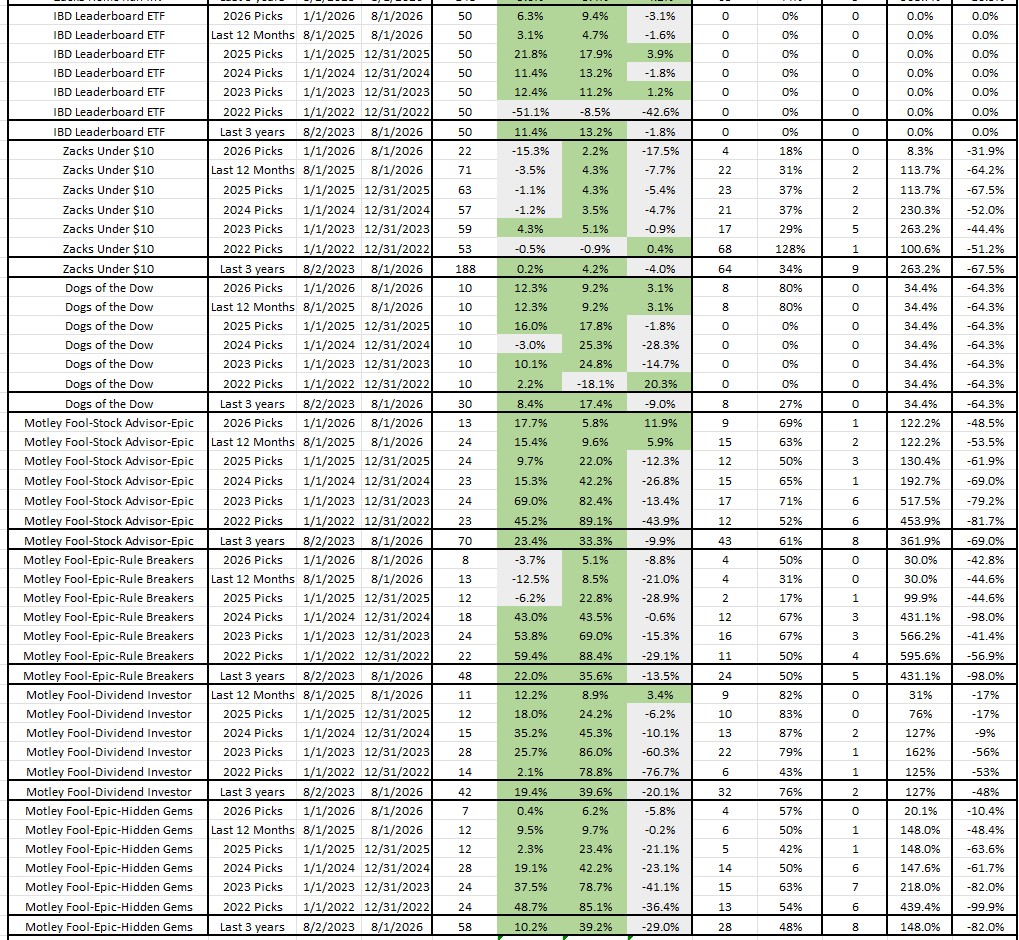
Rank of Top Stock Newsletters Last 3 Years, as of June 27, 2026
We are paid subscribers to dozens of stock and option newsletters. We actively track every recommendation from all of these services, calculate performance, and share our results of the top performing stock newsletters whose subscriptions fees are under $500. The main metric to look for is "Return vs S&P500" which is their return above that of the S&P500. So, based on June 27, 2026 prices:
Summary: 2 picks per month based on Seeking Alpha's Quant Rating; consistently beating the market every year since launch; tells you when to sell and they have sold almost half. See complete details in our Alpha Picks Review. Or get their Premium service to get their QUANT RATINGS on your stocks to better manage your current portfolio--read our Is Seeking Alpha Worth It? article to learn more about their Quant Ratings.
Summary: 10 stock picks per year on January 1st based on Zacks' Quant Rating; Retail Price is $495/yr and includes 6 different services including those below. Read our Zacks Review.
Summary: 10 stock picks per year on January 1st based on Zacks' Quant Rating; Retail Price is $495/yr and includes 6 different services. Read our Zacks Review.
Summary: All it requires is an email address to get their #1 stock pick free; 60+ stock picks per year, segmented by industry; consistently beating the market every year; retail price is $365/yr but save try it for $99. Read our Moby Review.
Summary: About 1 pick/week focusing on short term trades; Lifetime average return of 355% vs S&P500's 149% since 2015. Retail Price is $379/yr. Read our TipRanks Review.
Summary: 2 picks/month and 2 Best Buy Stocks lists focusing on high growth potential stocks over 5 years; Retail Price is $199/yr. Read our Motley Fool Review.
Summary: Rule Breakers is included with the Fool's Epic Service. Get 5 picks/month focusing on disruptive technology and business models; Lifetime average return of 355% vs S&P500's 149% since 2005; Now part of Motley Fool Epic. Read our Motley Fool Epic Review.
Top Ranking Stock Newsletters based on their last 3 years of stock picks covering 2026, 2025, 2024, and 2023 performance as compared to S&P500. S&P500's return is based on average return of S&P500 from date each stock pick is released. NOTE: To get these results you must buy equal dollar amounts of each pick on the date the stock pick is released. Investor Business Daily Top 50 based on performance of FFTY ETF. Performance as of April 5, 2026.