The Secret Language
Most people meet the stock market for the first time as a set of numbers on a screen.
Maybe it’s a scrolling ticker on TV. Maybe it’s red and green bars flashing past faster than you can interpret them. It looks technical. Cold. Like a language you were never taught.
For Mark, it started earlier—and quieter.
Every morning at the kitchen table, the business section of the Washington Post lay open like a map. His dad sat with it spread wide, eyes moving across tiny ticker symbols and fractions that might as well have been Greek to a teenager wandering into breakfast half-awake.

“What are all these numbers?” Mark asked. “What does this mean?”
His dad didn’t shrug. He didn’t say, “You’ll get it when you’re older.” He pulled Mark in and started translating—just enough to spark curiosity.
But the real education didn’t happen in the newspaper.
It happened at the library.
This was before investing apps, before instant charting tools. Research meant walking through quiet aisles, pulling annual reports from shelves, and sitting shoulder to shoulder at long wooden tables under fluorescent lights. It meant flipping through dense pages, tracing numbers with your finger, and learning to compare companies the only way you could back then: slowly, carefully, and with evidence.
Balance sheets. Income statements. Footnotes.
No shortcuts. No “hot tips.” Just the discipline of figuring out what a company actually was—and whether it deserved your money.
Then came the moment that changed everything.
His dad opened a brokerage account and dropped in $2,000—real money—and told his teenage son to pick his first stock.
No hand-holding. No fake portfolio. “I’ll help you,” he said, “but you’re the one deciding.”
Mark did the work the way he’d been taught—by researching and comparing companies. He chose a pest control company based in Atlanta and bought 100 shares at $12.
By the end of the summer, the stock was $16.
On paper, that was a $400 gain.
But the number wasn’t what made it unforgettable.

At the time, Mark was also working at McDonald’s for minimum wage. To clear $400, he would’ve had to stand on his feet for well over a hundred hours—shift after shift—coming home smelling like fryer grease and exhaustion.
Meanwhile, this money came from a few focused hours in the library and one decision he could explain.
That was when his perspective completely changed. He realized you can spend your whole life trading hours for dollars… or you can learn how to make decisions that let your money do some of the work for you.
And he learned something else: if you don’t know what you’re doing, the market doesn’t just “teach you.” It charges tuition.
College Years
Fast-forward a few years.
Mark followed that obsession into a Master’s program in Finance at Georgia Tech. He walked in expecting the same sense of discovery he’d felt in the library, the moment where theory met reality.
Instead, he found a thousand-page textbook, long lectures, and rows of students half-listening while a professor drew formulas on a dry-erase board.
The math was there. The theory was there.

But the experience was missing.
Mark sat in the room as one of the rare students who had already put real dollars into real trades. He knew what it felt like to watch a stock move after you owned it. To second-guess. To feel that jolt when your account balance swings and you realize it’s not hypothetical anymore.
He looked around and saw a problem no textbook could fix.
His classmates were memorizing definitions of “risk” without ever feeling risk. They were calculating returns without ever living with uncertainty.
On the surface, everyone was “learning.” But many of these students would graduate into roles advising clients, managing portfolios, and making decisions with real money—armed with theory, but untrained in the emotional realities that cause people to panic, chase, freeze, or blow themselves up.
Week after week, Mark watched it happen students got better at passing exams, but not better at investing.
Then one day, he ran into his professor in the hallway.
“Mark,” the professor said, “you really seem to love this topic. How do you like my class so far?”
There was a safe answer. Instead, Mark told the truth.
“No offense,” he said, “but I find your class boring.”
The words hung there. It was a risky thing to say to the person who controlled your grade.
The professor’s expression tightened. “Boring? What do you mean my class is boring?”
Mark didn’t back down.
He told him he’d been investing for a while. He explained that most students had no idea what it feels like to make a decision when money is on the line—what it feels like to buy, watch, doubt, hold, sell, regret, repeat.
“The content isn’t the problem,” Mark said. “It’s the distance.”
The distance between a multiple-choice question about “optimal portfolio allocation” and the moment you watch your own portfolio drop 20% and have to decide whether you’re disciplined enough to do nothing.
That distance is where people get hurt.
You can ace every exam and still panic-sell the first time real fear shows up. You can memorize “diversification” and still put half your savings into one “hot stock” because someone sounded confident.
The professor listened, then asked a simple question:
“So, what would you do differently?”
Mark didn’t hesitate.
He described a different class: one where every student received a million dollars of virtual money and had to manage it like a real fund. Real stocks. Real prices. Real decisions. A semester-long experience where you couldn’t hide behind theory.
The professor nodded.
“That sounds like a great idea,” he said. “But I’m too lazy to keep track of all those trades.”
And in that one sentence, everything snapped into focus.
Students didn’t need another lecture. They needed a safe place to practice—before practice cost them real money.
Mark walked away with a question he couldn’t shake:
If nobody was going to build the bridge between theory and experience… was he really going to watch an entire generation step into the market unprepared?
Building a Bridge in the Dark
Mark graduated, took a job at Deloitte, and worked the sixty-hour weeks like any other young CPA climbing the ladder.
By day, he audited other people’s numbers. By night, the hallway conversation kept replaying in his head.
Back then, there was no “stock market simulator.” No easy way for professors to run real-time portfolios at scale. No infrastructure. No automation. And certainly no internet-powered dashboard you could spin up overnight.
So after long audit weeks, Mark came home, ate whatever was fast, and sat back down at his personal desk.
No team. No modern tools.
Just a phone line, a modem, and a stubborn idea:
What if investing education had a flight simulator?
This was the era of 1200-baud modems—that screeching, metallic dial-up sound as you connected to services like CompuServe and tried to pull market data without the line dropping. Every connection cost money. Every minute counted. One wrong character could corrupt the database and force him to start over.
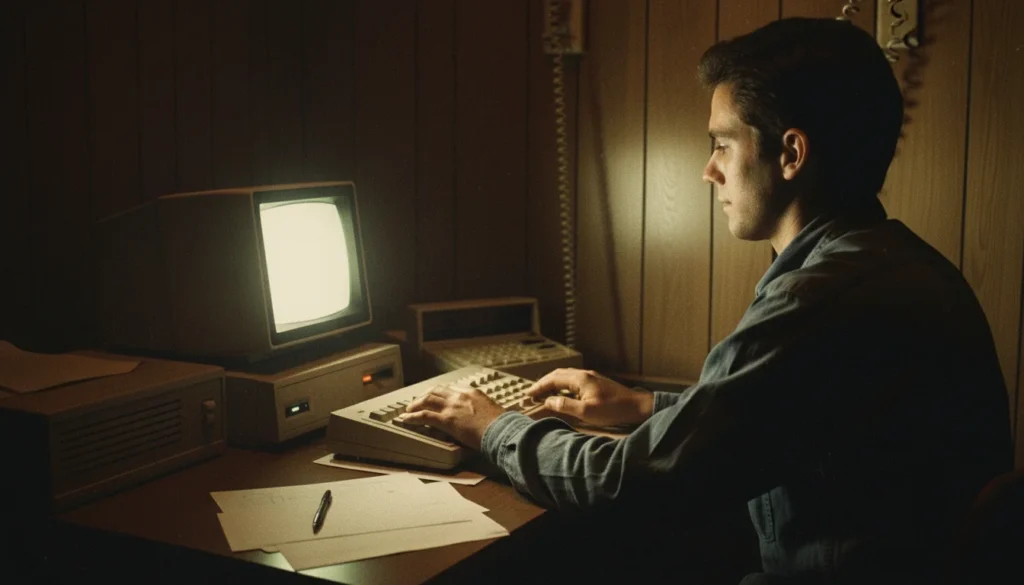
While coworkers blew off steam on Friday nights, Mark sat in a dark room lit by the green glow of a monitor, watching a blinking cursor that sometimes felt like it was mocking him.
Why are you doing this? You have a safe career path. Why build… a game?
But he knew it wasn’t a game.
It was a way for people to learn discipline, process, and emotional control before real money was on the line.
Back then, there was no “someone else.” No online brokers yet. No internet. No online games where you could practice anything, let alone investing. A stock market simulator simply didn’t exist. If he didn’t build a way for people to practice before they risked real money, nobody was going to do it for a long time.
So he kept going.
Eventually, the program worked.
In August 1990, he went back to Georgia Tech and walked into that professor’s office.
“You remember that stock-tracking idea we talked about?” he asked. “I finally finished the program. Can we try it next semester?”
The professor said yes.
They priced it at $12 per student. Thirty students signed up—his old professor’s class became the first to use it.
Mark turned his bedroom into a brokerage office: phone lines, fax lines, modem lines, and a 1-800 number open in the evenings so students could call in orders after the market closed.
And for the first time, students weren’t just studying the market.
They were experiencing it.
They felt the sting of a bad trade. They felt the relief of having one position drop while the rest held steady. They learned—viscerally—that diversification isn’t a definition. It’s a survival tactic.
At the end of the semester, Mark handed out a survey with ten questions: Did this help you understand stocks? Did this help you understand risk? Would you recommend it?
He collected the papers, walked out to the parking lot, and sat in his car—heat pressing in, hands almost shaking.
If this didn’t work, it wasn’t just a bad product. It was months of late nights and dial-up bills for nothing.
He flipped the first page.
10 out of 10.
Then the next.
10 out of 10.
Thirty students. Thirty perfect scores.
Sitting there, Mark realized he hadn’t just built software.
He had built the missing bridge.
And he couldn’t stop thinking: If thirty students could go from confused to confident in one semester… what happens when you give this kind of practice to everyone—before they risk a dollar of their own?
From One Classroom to the World
That answer didn’t show up overnight.
It arrived one semester at a time.
One class turned into many. Thirty students became hundreds. Then thousands. The bedroom brokerage grew into a global financial education platform. For years, Stock-Trak quietly did its job—giving finance students a safe place to practice before they ever touched real money.

If the story ended there, it would already be a win. But fear of the stock market doesn’t stop at the classroom door.
It lives in first paychecks and 401(k) enrollment forms. It shows up when someone finally has a little extra cash and freezes at the idea of clicking “Buy” in a brokerage account for the first time.
That’s where you come in.
Today, the mission that started in a Georgia Tech hallway has moved far beyond campus walls.
We still believe what those thirty perfect scores proved: you learn to invest the right way by practicing before you risk your real money. You build confidence by making decisions, seeing the results, and adjusting—without blowing up your future because you guessed wrong on your first trade.
That’s why Wall Street Survivor exists.
We provide a safe stock market simulator and plain-English guides to help you overcome the fear of clicking “Buy” and investing your own money with total confidence.
Think of it as driver’s ed for the market. We take you to the empty parking lot and let you get comfortable behind the wheel before you merge onto the highway.
On Wall Street Survivor, you can:
- Practice with a virtual portfolio that moves with the real market
- Learn how orders actually work—market, limit, stop—without the anxiety tax
- See what diversification feels like when one stock tanks and your whole portfolio doesn’t
- Get free courses and guides written in everyday language, not Wall Street jargon
No one is born knowing how to invest. You aren’t “behind.” You aren’t “too late.” You just haven’t had a safe place to practice yet.
For decades, the simulator lived mostly in classrooms, under course codes and syllabi. Then came the realization that the people who needed this the most weren’t just students—they were nurses, construction workers, freelancers, young parents, late starters, anyone who had ever stared at an investing app, felt their stomach drop, and closed it without doing anything.
So the mission expanded.
Stock-Trak for schools. Wall Street Survivor for everyone else.
Same engine under the hood. Same “flight simulator” philosophy. But now pointed at a bigger question:
What if you didn’t have to be in a finance class to get the kind of practice that used to be reserved for students?
What if you could log in for free, test ideas, make mistakes with virtual dollars, and learn how the market really behaves—before a single cent of your real savings is at risk?
We’ve been in this space since financial simulations didn’t exist. And we’re still here for the same reason we started:
Because smart investing isn’t about getting lucky. It’s about learning how to make decisions you can live with—long before real money is on the line.
When you’re ready to open a real brokerage account, it won’t feel like a leap off a cliff. It’ll feel like the next logical step in a journey you’ve already rehearsed.
Welcome to Wall Street Survivor. Let’s get started.
Mark Brookshire, CEO of the Stock-Trak family of financial education sites.