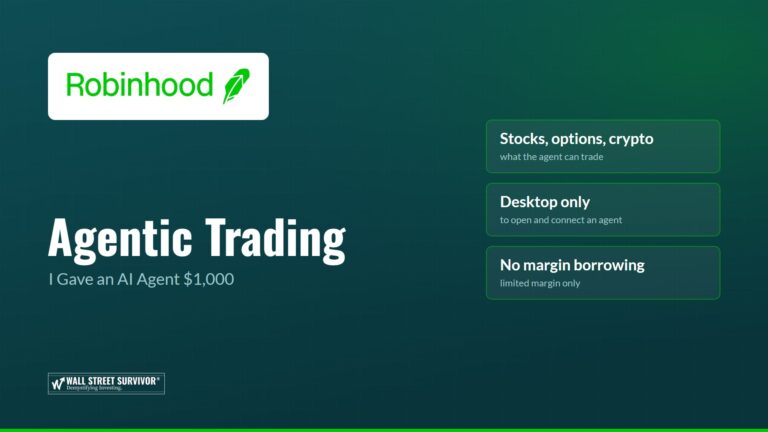
Robinhood Agentic Trading lets you connect an AI agent, like Claude, ChatGPT, Cursor, Grok, etc., to a dedicated Robinhood account and let it place real trades. Not suggestions. Trades.
On 6 August 2026 I funded one with $1,000, gave it a mechanical rotation strategy, and left it running unattended.
The trading part worked. The setup very nearly didn’t.
Before any of it: handing money to software is exactly the territory regulators are watching, and the SEC, NASAA and FINRA published a joint alert on AI and investment fraud worth five minutes of your time. Agentic Trading isn’t a scam. It’s a brokerage product from a regulated broker-dealer. But the scepticism that alert teaches is the right frame of mind for the rest of this page.

Get a FREE stock worth up to $200 the moment you fund a new account with just $10, plus up to $15,000 more per year in free stock when you refer friends. U.S. residents only.
- U.S. stocks, ETFs, options, and cryptos, all commission-free
- Excellent for beginners and advanced investors
- Cash management account and credit card
- Upgrade to Gold for better rates on cash, margin, and a 3% IRA contribution match
- SIPC protected up to $500,000, plus FDIC coverage on uninvested cash
- Connect your favorite AI agent directly to your account and let it research, monitor, and trade for you with a dedicated funded account and a one-tap kill switch you control
- Predictive Markets: Trade real-time "Yes/No" event contracts on sports, politics, weather, and finance. Put your read on the world to work, with instant settlement when the outcome hits
Open and fund a Robinhood Agentic account to let your AI agent trade
What Robinhood Agentic Trading actually is
Robinhood opened its brokerage to AI agents through an MCP server. MCP stands for Model Context Protocol, an open standard that lets an AI connect to outside services and do things instead of just talking about them. Point your agent at Robinhood’s MCP endpoint, and it gains a set of tools: pull quotes, read your positions, run a screener, place an order.
The trades land in a separate Agentic Account, a self-directed individual investing account that exists specifically to be the agent’s sandbox. You fund it with an amount you’ve decided the agent is allowed to touch. Your main portfolio isn’t in its reach for trading.
It handles long equities, options and crypto orders. Robinhood documents setup for Claude Code, Claude Desktop, ChatGPT, Codex, Codex CLI, Cursor and Grok, and anything else that speaks MCP should work. It’s one URL in a config file.
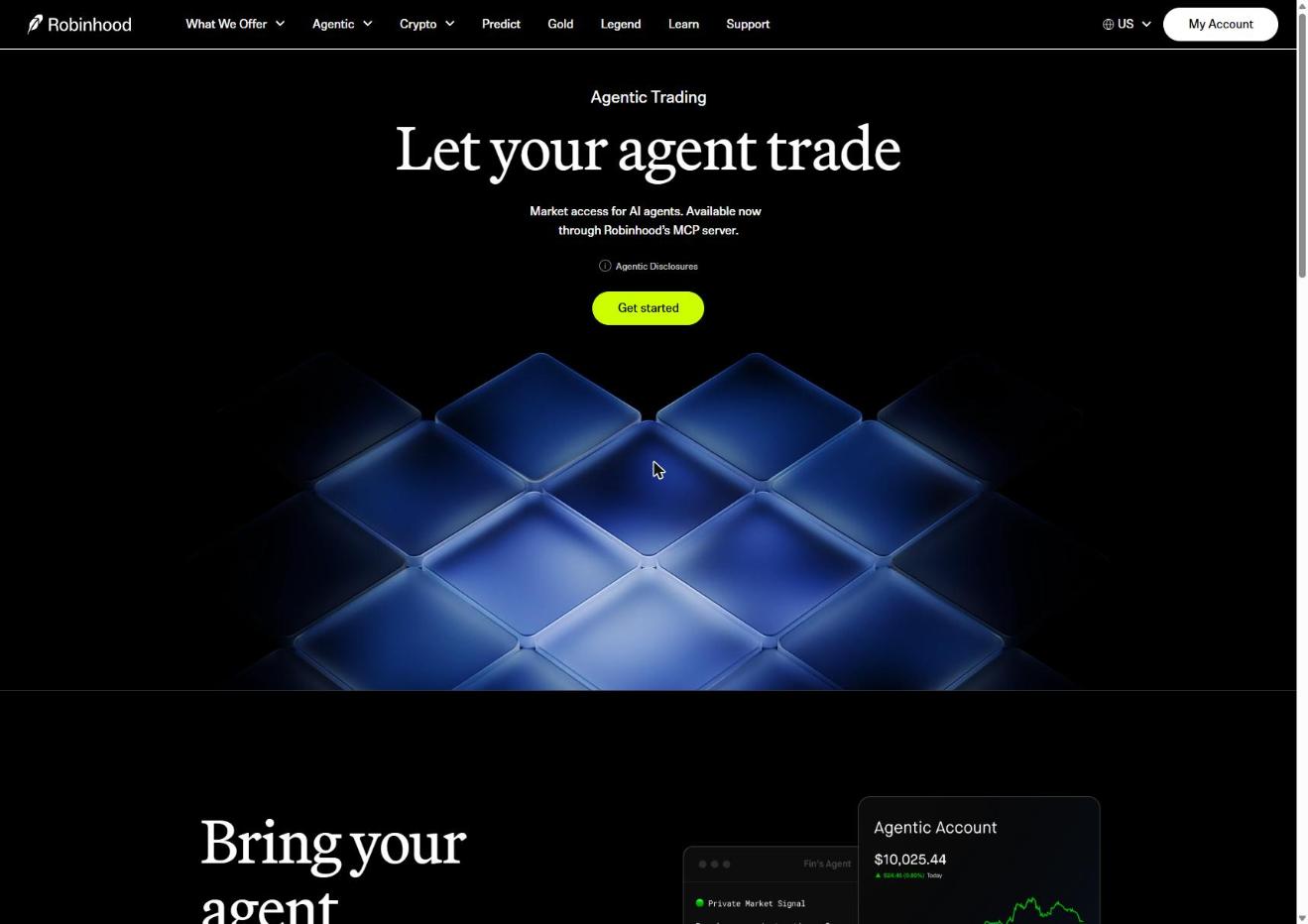
Set up your own agent, open and fund a Robinhood Agentic account
The strategy I gave it
I wanted something mechanical enough that I could tell whether the agent was working, not whether my judgement was. So: a two-name rotation, fully invested at all times, between one AI-hardware name and one enterprise-software name: AMD and Salesforce (ticker: CRM). Each day, put 100% of the account into whichever of the two posted the stronger after-hours return on the most recently completed session. Hold until the leader flips. One round trip a day, maximum.
The idea behind it was that AI-hardware and SaaS names have been trading against each other on a daily basis, so yesterday’s laggard is often today’s leader. I backtested it before committing real money, which I’d suggest to anyone doing this. Backtesting can’t tell you what will happen next, but it forces you to write the rules down tightly enough that an agent can follow them without interpreting.
I found the backtesting the most useful part of the experience so far. The ability to test any ideas as a trading strategy is fun for anyone interested in investing, and the connection between natural language prompting and Robinhood market data is awesome.
It went live on 6 August 2026 with an opening position of 2 shares of AMD at $492.3099, so $984.62 of the $1,000 deployed, the rest left as change.
To be explicit: this is a record of what one agent did in one account, not a suggestion that you trade either of these stocks or run this strategy. Two names is a concentrated bet by design, and concentration cuts in both directions.
What happened (so far)
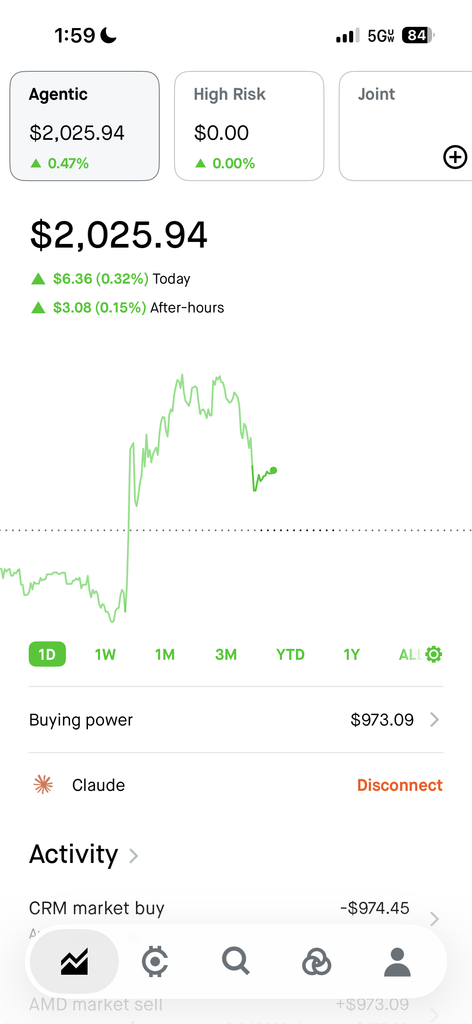
The account is actively trading. I started August 6th, 2026, and on August 28th I notched my first profits. As of today the account is up ~$25. That may not sound like a lot, but I think it’s mind-blowing that I’ve made $25 with zero manual intervention.
| Started | August 6 2026 · $1,000 funded · $984.62 deployed |
| Ended | August 31 2026 · $2,000 funded · $974.45 deployed |
| Change | + $25.94 |
| Trades placed without my confirmation | 4 |
| Rotations executed | 3 |
It took me about two weeks to iron out the mechanics and make it truly automated. I ran into several issues, so here are some tips on how to learn from my mistakes:
It’s desktop-only, and there’s a prerequisite account
You cannot open the Agentic account or authenticate the agent on a phone. If you start on mobile you have to copy the onboarding URL into a desktop browser. You also need an existing Robinhood individual investing account in good standing before you can open an agentic one. It’s an additional account, not a first account, and it counts toward the ten self-directed individual accounts Robinhood allows.
Margin: the setting I couldn’t find, because it isn’t there
You may notice that I said I was trading with $1000, but my account says $2025. I didn’t think through settlement times and the availability of cash for daily trading.
There are three ways to solve for this
1. Enable margin (borrowing money from the brokerage to trade with)
2. Reducing the trading frequency to account for settlement time
3. Deposit more cash
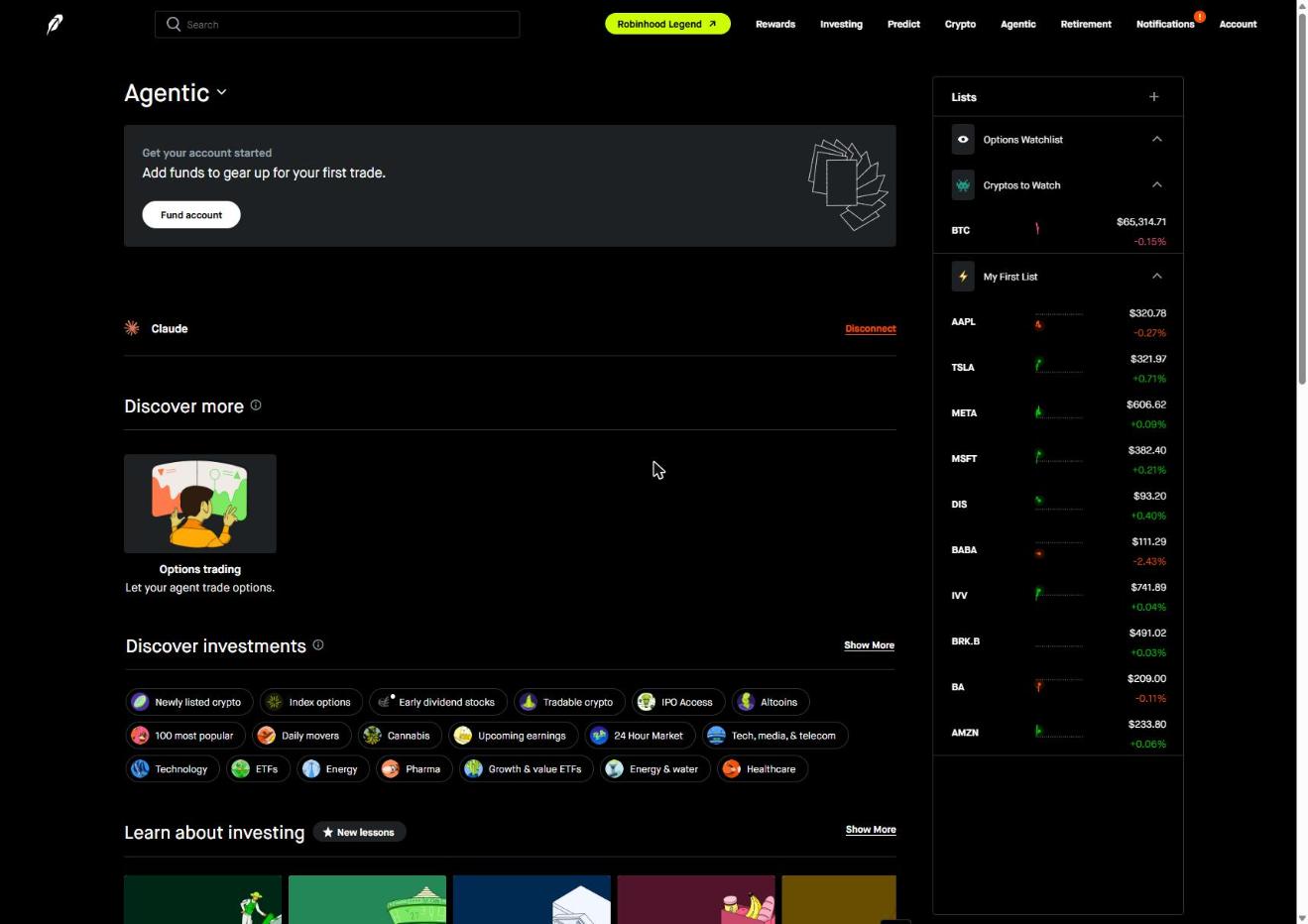
Enabling margin trading is risky. If this wasn’t an experiment, I wouldn’t have explored it as an option. Despite it being the easiest solution at first glance: margin borrowing is not enabled for Agentic accounts. It isn’t hidden in a submenu and it isn’t gated behind a tier. It doesn’t exist yet. I went in circles through Investing Settings looking for a switch that wasn’t there.
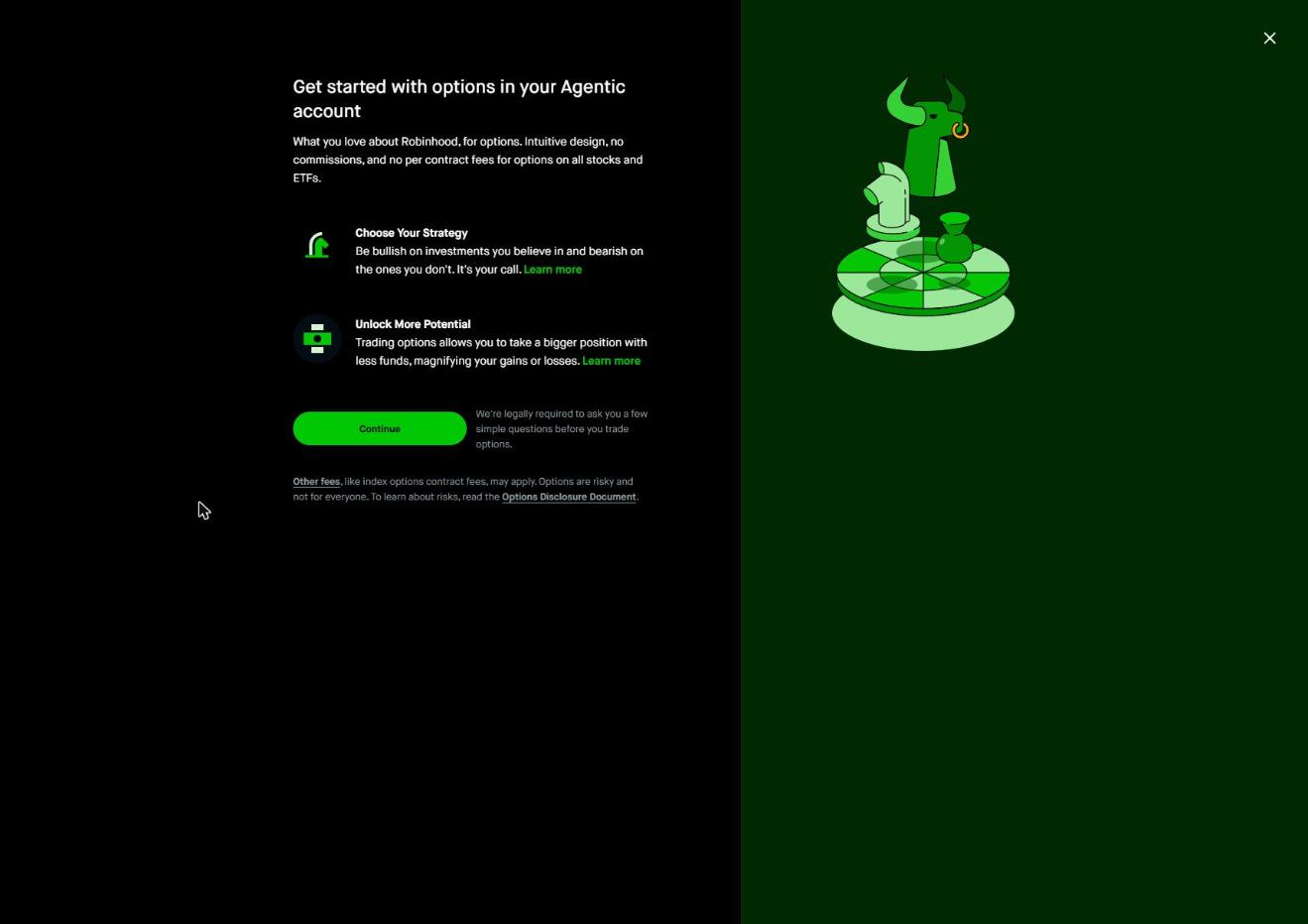
What does exist is limited margin, which is a different thing. It lets you trade with unsettled funds from closing stock and option positions instead of waiting for settlement. No borrowing, no leverage. You’re just not stuck for a day. You can open the Agentic account as a limited margin account, or upgrade an existing agentic cash account in Investing Settings.
If you skip it, an agentic cash account waits one business day for funds from closing stock and option positions to settle. For a strategy that rotates daily, that single business day is the difference between the strategy running and the strategy stalling. That’s the wall I hit before working out what the setting was called.
“Automated” had an asterisk
I set up the rules to trade at market open each day. By the time I had the settlement/margin issue worked out, I realized that my trades weren’t executing at open. I would open my Claude desktop app and see the little yellow hand by my “scheduled tasks”, only to realize the prior day’s after hours returns hadn’t been evaluated yet, and no trades had been made.
Two things were happening:
1. I hadn’t activated “skipping all approvals”
2. Claude still required the desktop app to be open in order to run the “scheduled” tasks.
The first was a simple fix. I had to make a switch in my account settings to skip all approvals for scheduled tasks. Depending on which LLM you connect, this could look very different. For Claude, once surfaced the issue was very easy to fix.
Now issue #2. Living in California, I am often not online for market open (6:30AM Pacific time). When I wasn’t online, given the desktop app needed to be open, my trade would not execute until I logged on. So I either needed to change my sleep schedule or trading rules. But miraculously, Anthropic happened to make an update that allows certain tasks to run without the desktop app being opened on a local device. Total luck.
That’s when the strategy started to work.
What agentic trading can’t do yet
The gaps are worth knowing before you fund anything, because several of them will decide whether your strategy is even possible:
- Long orders only. Equities, options and crypto, but the agent places long orders. No shorting.
- No margin borrowing. Limited margin only, as above.
- Crypto is fenced. You need a Robinhood Crypto account matched to the agentic account and you have to accept the updated crypto agreement. Your agent can trade crypto but cannot transfer, stake or lend it, and it can’t open the crypto account for you.
- Crypto isn’t available in every state, including New York. Move to a restricted state and your agent stops placing new crypto trades. Open orders aren’t cancelled. Move back and access returns after 45 days.
- It’s an additional account. You need a primary individual investing account in good standing, and the agentic account counts toward your ten self-directed individual accounts.
The risks
Robinhood’s own disclosures here are blunt, and you should read them instead of scrolling past:
- You can lose the entire amount you fund. An AI strategy can perform badly, move fast, and be hard to monitor or stop in real time.
- Agents make mistakes. They misread instructions, act on stale or incomplete information, and behave unpredictably. Robinhood doesn’t guarantee anything an agent outputs and isn’t responsible for losses it causes.
- Robinhood doesn’t vet your agent. In its words, it does not control, supervise, monitor, recommend or audit third-party AI agents. That’s your call and your risk.
- Your data leaves Robinhood. Once it reaches your AI provider it’s governed by that provider’s terms, not Robinhood’s.
- Read access is broader than you’d assume. The agent can only trade in the agentic account, but it can read all of your Robinhood accounts: account numbers, every position and balance, your full transaction and order history, your watchlists and scans. Funding the agentic account with a small amount limits what can be traded away, but not what can be seen.
- Without per-trade approval, it trades without asking. That’s the feature. Treat it as one.
Brokerage services come through Robinhood Financial LLC, a registered broker-dealer and member SIPC, with clearing through Robinhood Securities, LLC. SIPC covers you if the broker-dealer fails; it does not cover losing money on a trade, whoever or whatever placed it.
Decide your agent’s budget first, then open and fund the account
A note on the Agentic Credit Card
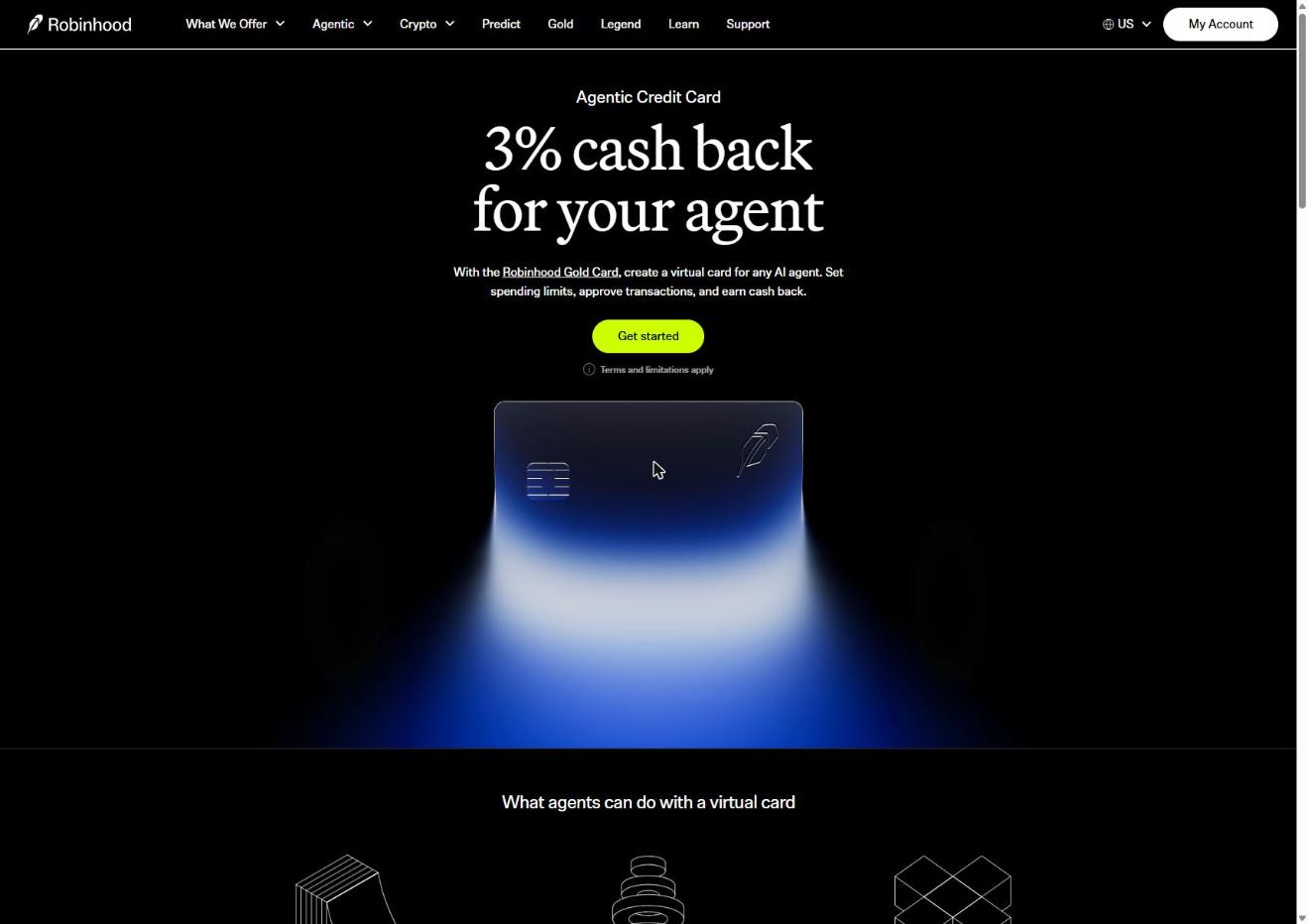
Robinhood shipped a second agentic product alongside the trading one: virtual credit cards you can issue to an AI agent, with spending limits, optional transaction approvals and revocable access. It pays 3% cash back across all categories, and the use cases Robinhood pitches are errands, not investing: tickets, reservations, restocking.
One caveat that matters: it’s a feature of the Robinhood Gold Card, which is a credit card subject to approval and underwriting, and a separate product from the brokerage account. Interesting, and not the same thing as agentic trading.
Who this is for, and who should stay away
Try it out if you can express a strategy as explicit rules, you’re comfortable leaving a machine running, and you can fund the account with money you’d be fine losing. The walled-budget design is the best thing about it: the blast radius is whatever you put in.
Skip it if you want set-and-forget. It’s not quite there yet. If you need margin borrowing, it’s not available. If you’d rather not have an AI provider holding read access to your whole Robinhood history, that’s a reasonable position and this product isn’t for you. And if “trades without asking” makes you uneasy, believe that instinct.
The verdict
Agentic Trading is the most interesting thing Robinhood has shipped in a while, and it’s a genuine first release, not a finished product. The core works: an agent really can research, decide and trade in a walled-off account, and the safety design of a dedicated budget, per-trade notifications and instant disconnect is thought through, not bolted on.
The rough edges are all in the “unattended” part. Your agent runs on your hardware, so the automation is only as reliable as the machine it sits on. Margin borrowing isn’t there. Permissions force a real trade-off between automation and oversight.
If you were waiting for a broker to open real market access to AI agents, this is it, and it’s worth $100 of curiosity money before it’s worth $10,000 of conviction. Fund it with an amount whose loss would annoy you but not hurt you, and watch it more closely than “automated” suggests you’d need to.
FAQs
Yes. If you don’t require approval on each trade, a connected agent places orders without asking you first. You can require per-trade approval instead, or disconnect the agent at any time from the app.
Margin borrowing isn’t enabled for Agentic accounts. Limited margin is available, which lets you trade with unsettled funds from closing stock and option positions. That’s useful for a strategy that trades daily, but it isn’t leverage.
Robinhood documents setup for Claude Code, Claude Desktop, ChatGPT, Codex, Codex CLI, Cursor and Grok, and any agent that supports MCP connections can use the same endpoint.
The account design limits what can be traded: the agent only trades in the agentic account you fund. But it can read every Robinhood account you hold, AI agents make mistakes, and Robinhood doesn’t vet the agent you connect. You can lose everything you fund.
Yes. You need a primary individual investing account in good standing before you can open an agentic account, and setup has to be done on a desktop.