Robinhood now lets you trade on the outcome of real-world events, from Fed rate decisions to elections to sports, through a product it brands Predict. Under the hood, what you’re actually buying is an event contract: a regulated derivative that pays $1 if you’re right and $0 if you’re wrong. This article walks through what Robinhood prediction markets are, how event contracts work and what the Commodity Futures Trading Commission says about them, what they cost after the June 2026 fee change, who’s eligible to trade, and the risks worth understanding before you fund an account.

Get a FREE stock worth up to $200 the moment you fund a new account with just $10, plus up to $15,000 more per year in free stock when you refer friends. U.S. residents only.
- U.S. stocks, ETFs, options, and cryptos, all commission-free
- Excellent for beginners and advanced investors
- Cash management account and credit card
- Upgrade to Gold for better rates on cash, margin, and a 3% IRA contribution match
- SIPC protected up to $500,000, plus FDIC coverage on uninvested cash
- Connect your favorite AI agent directly to your account and let it research, monitor, and trade for you with a dedicated funded account and a one-tap kill switch you control
- Predictive Markets: Trade real-time "Yes/No" event contracts on sports, politics, weather, and finance. Put your read on the world to work, with instant settlement when the outcome hits
Open a Free Robinhood Account and Add Funds to Start Trading Event Contracts
What Are Robinhood Prediction Markets?
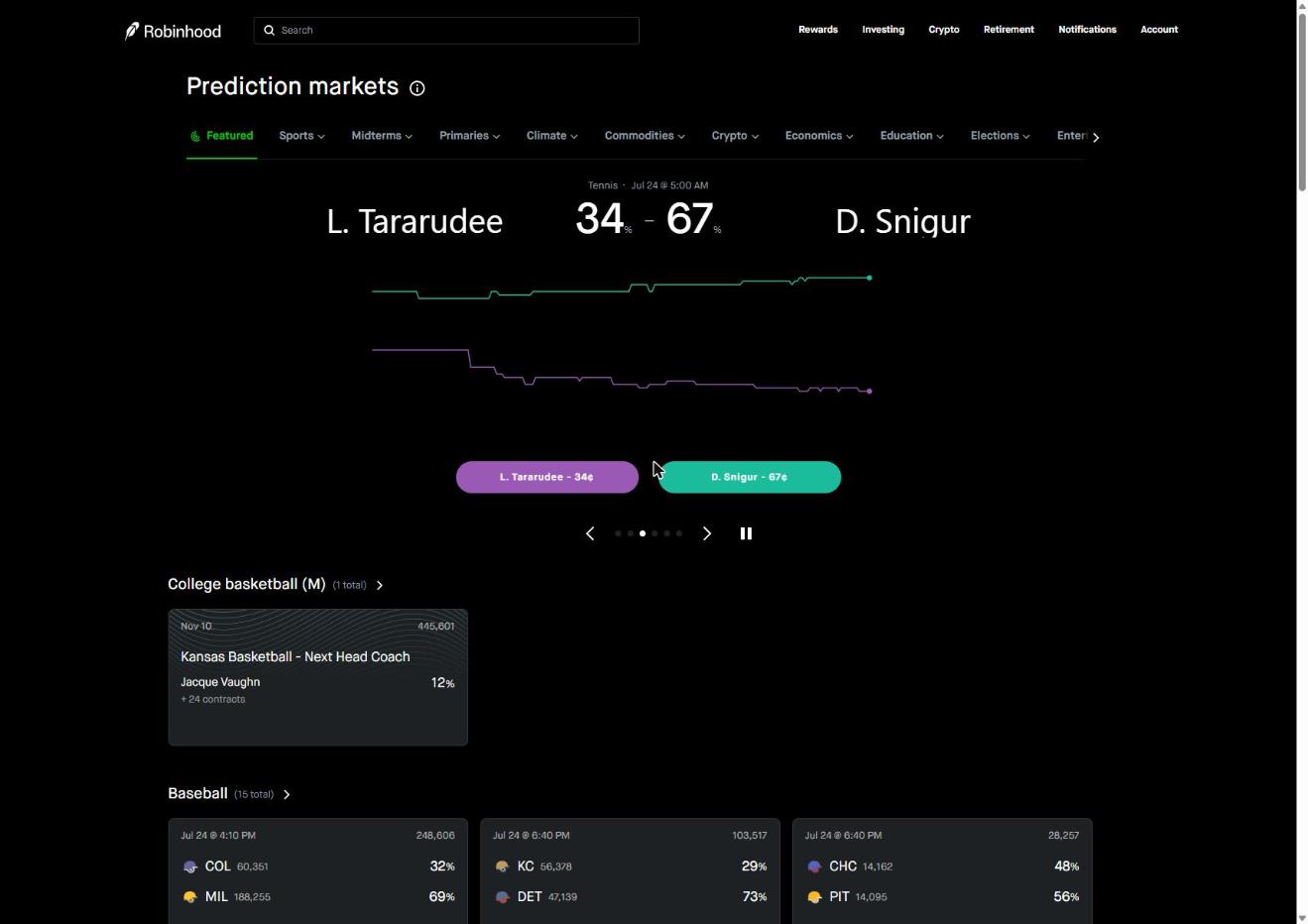
Predict is the name Robinhood gives the tab in its app where you trade event contracts. The instrument itself isn’t a Robinhood invention. Event contracts are offered through Robinhood Derivatives, LLC (RHD), a registered futures commission merchant with the CFTC and a member of the NFA, and they trade on one of three exchanges: KalshiEX LLC, ForecastEX LLC, or Rothera Exchange and Clearing LLC. Rothera is a CFTC-licensed exchange and clearinghouse Robinhood runs through a joint venture with Susquehanna International Group.
You’re not betting against Robinhood, and you’re not betting against another customer directly. You’re trading a contract on a regulated exchange, the same basic architecture as futures and options, just built around a yes-or-no question instead of a price level.
How Do Robinhood Prediction Markets Work?
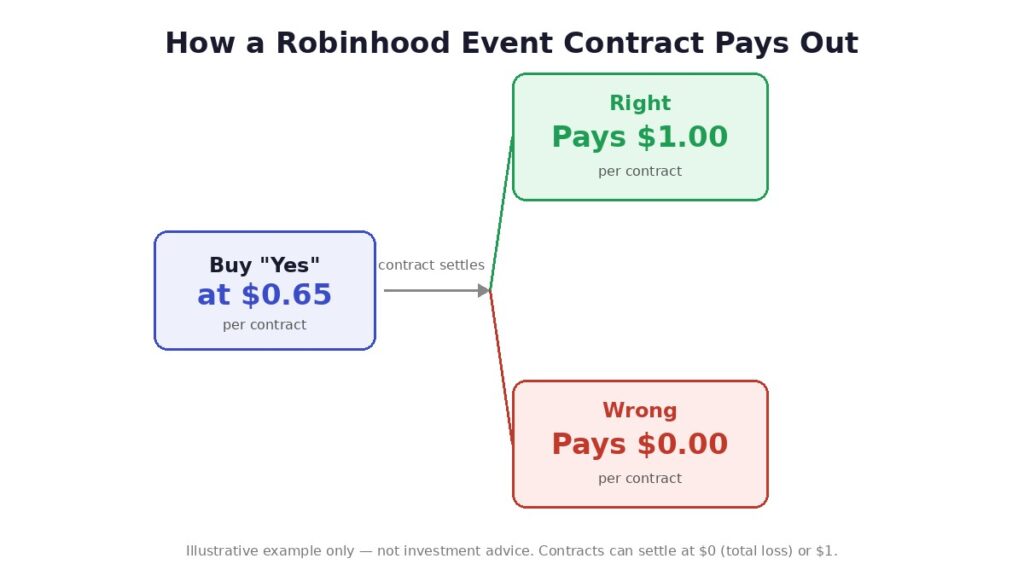
Every event contract is a binary Yes/No question: “Will the Fed cut rates in September?” or “Will Team X win the championship?” There are two possible outcomes at settlement: the contract pays $1 per contract if you’re right, and $0 per contract if you’re wrong. There’s no partial credit and no sliding payout; it resolves to one or the other.
Before settlement, contracts trade anywhere from $0.01 to $0.99, and that price reflects the market’s implied probability. A contract trading at $0.65 implies the market currently sees roughly a 65% chance of that outcome. It is not a forecast, and it is not Robinhood’s opinion; it’s simply what buyers and sellers are willing to pay right now, and it moves as new information arrives. Robinhood’s own guidance: if a question is worded as a double negative, read it carefully before you pick a side.
What “Yes” and “No” Really Mean
Buying “Yes” means you’re paying today’s price for a claim that pays $1 if the event happens as stated, and $0 if it doesn’t. Buying “No” is the mirror image: you’re taking the other side of the same question. Because prices move continuously between $0.01 and $0.99, you don’t have to hold a contract to settlement; you can sell it before the event resolves if the price moves in your favor (or against you).
How Contract Prices Reflect Probability
Think of the price as a running vote count, not a guarantee. As money moves in and out of a contract, the price shifts to reflect what the market currently believes is likely. That’s a useful way to read the market, but it is not the same thing as a prediction of what will actually happen. A contract priced at $0.90 can still settle at $0, and does, whenever the less-likely outcome occurs.
What You Can Trade on Robinhood Predict
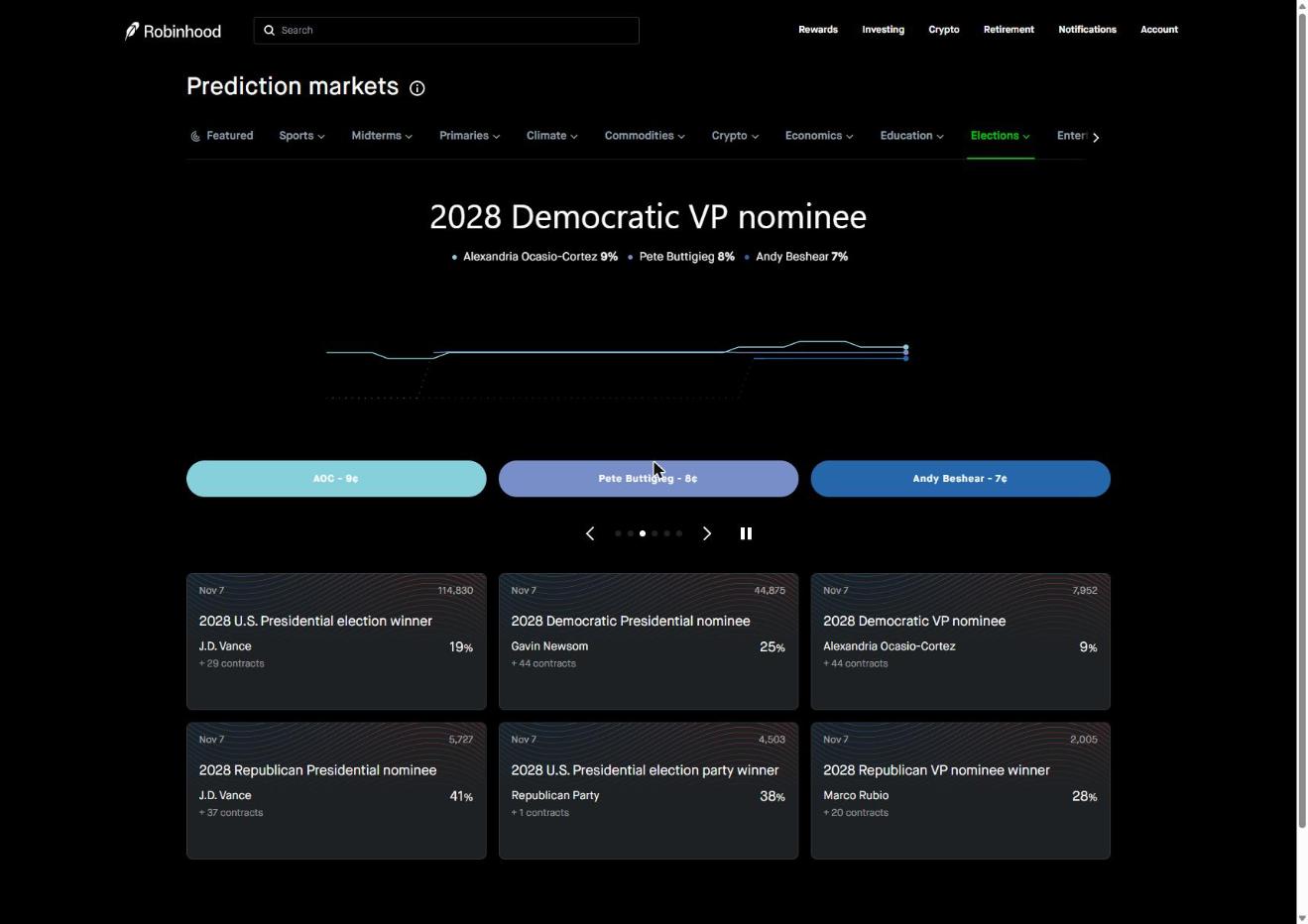
As of August 2026, Robinhood Predict covers a wide range of categories, and the mix goes well beyond sports:
- Economics, including Federal Reserve rate decisions
- Politics and elections
- Crypto
- Climate
- Commodities and metals
- Entertainment
- Education
- Technology
- Esports
- Sports: NFL, NBA, WNBA, college basketball, baseball, tennis, cricket, golf, soccer, MMA, boxing, racing, and chess
Sports gets the most attention because it’s the most familiar entry point, but the fastest-growing categories on the platform right now are economic and political: questions like Fed policy and election outcomes, where an event contract lets you take a direct position on a real-world question rather than trading a stock as a proxy for it.
Prediction Markets vs Sports Betting: What’s Actually Different
Robinhood is explicit that event contracts are not bets: they’re a form of speculation in prediction markets, and the distinction is structural, not just semantic.
A sports wager is a private agreement with a bookmaker at fixed odds the house sets; you’re taking the other side of a bet against the house, and you’re typically locked in until the event ends. An event contract is an exchange-traded derivative: the price is set by the market (other buyers and sellers), not by a bookmaker, it’s cleared through a CFTC-regulated exchange, and because it trades continuously between $0.01 and $0.99, you can sell your position before the event resolves instead of waiting it out. The economics and the oversight are different from a sportsbook, even when the underlying question (who wins a game) sounds the same.
This difference is why regulators are paying close attention to sports-based event contracts specifically. Sports contracts are the most actively contested corner of this market: the category has drawn regulatory scrutiny, and some states restrict it outright (more on that below). If you’re drawn to Predict mainly for economic, political, or crypto questions, that regulatory debate is largely beside the point; if you’re drawn to it for sports, it’s worth knowing the ground is still shifting.
What Event Contracts Cost on Robinhood
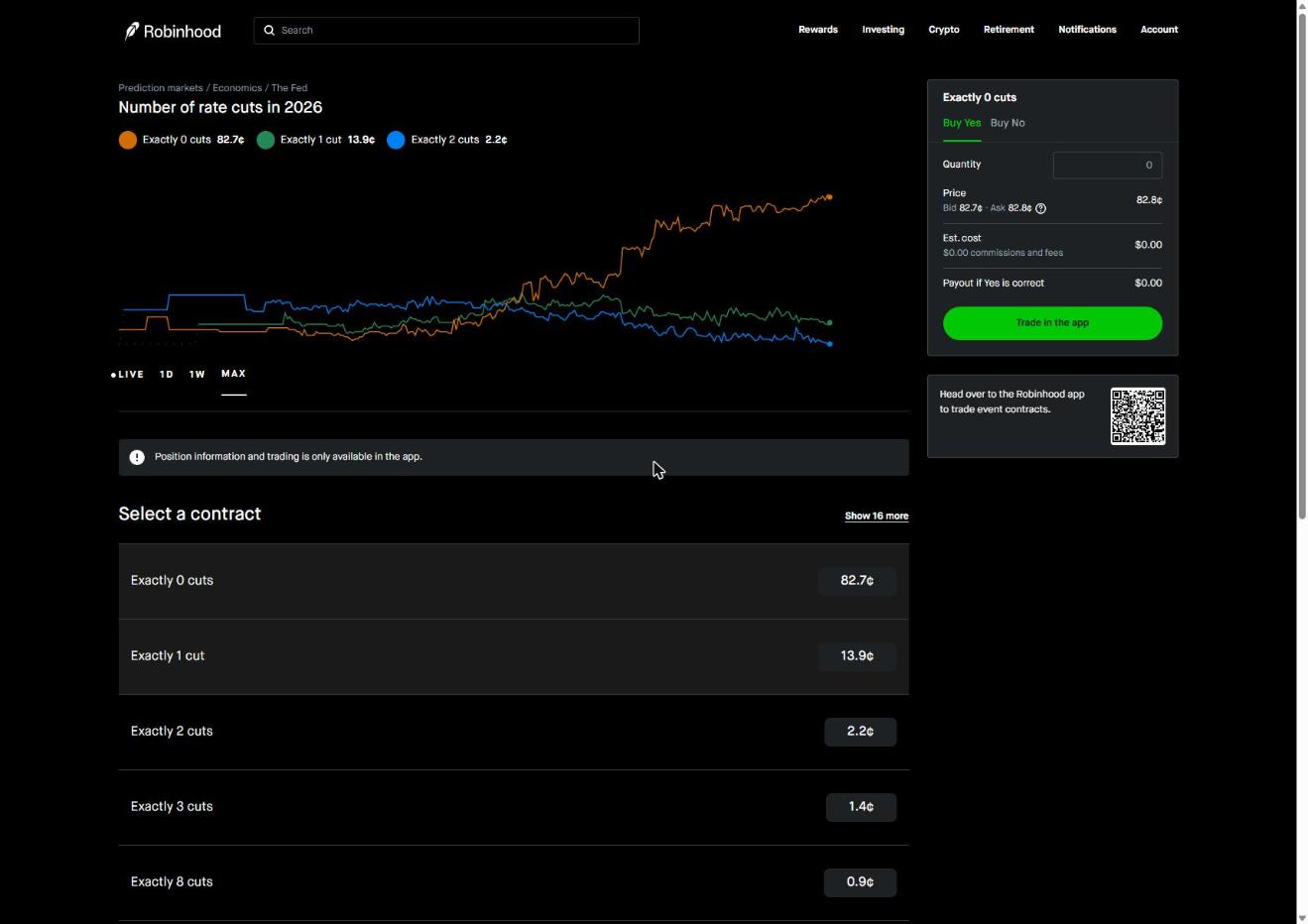
The fee structure changed on June 1, 2026. Robinhood moved from a flat per-contract fee to a probability-weighted commission:
commission = k × p × (1 − p) × c
where k is 5% for Robinhood Gold members or 10% for everyone else, p is the contract price expressed as a decimal, and c is the number of contracts. The result is rounded up to the nearest $0.01 and capped at $0.01 per contract. There’s also a separate exchange fee, up to $0.01 per contract, that varies by exchange. Both the commission and the exchange fee apply on the way in and the way out. Opening and closing a position are each their own trade.
Because the formula multiplies price by (1 − price), commissions are lowest at high-conviction prices near the extremes ($0.01 or $0.99) and highest near the middle ($0.50), where the cap tends to bind. Robinhood’s own worked example: buying 100 “Yes” contracts at $0.90, with a $0.01-per-contract exchange fee, costs $0.45 in commission with Gold ($91.45 total) or $0.90 without Gold ($91.90 total).
Robinhood’s published commission table for 100 contracts (Gold / without Gold) shows the pattern clearly: $0.01 → $0.05 / $0.10, $0.10 → $0.45 / $0.90, $0.25 → $0.94 / $1.00, the $0.28–$0.72 range → $1.00 / $1.00 (where the $0.01-per-contract cap binds), $0.75 → $0.94 / $1.00, $0.90 → $0.45 / $0.90, and $0.99 → $0.05 / $0.10.
A quick note on Gold: it does cut the commission rate in half, and that’s a real number worth knowing if you’re comparing costs. But it’s an optional add-on, not a requirement. You don’t need Gold to trade event contracts, and the account you actually need first is the free Robinhood brokerage account paired with a separate, approved Derivatives account (more on that below).
Fund Your Robinhood Account and See What’s Trading on Predict Today
Who Can Trade Event Contracts on Robinhood
Trading event contracts requires a separate, approved Robinhood Derivatives account. It’s distinct from a standard brokerage account, and approval considers your trading experience, investment profile, and state of residence.
A few restrictions to know up front, because they’ll affect whether you can actually use this product:
- Predict is mobile-app only. You can view contracts on the web, but you can’t trade them there, and they’re not available on Robinhood Legend.
- Maryland residents cannot trade event contracts at all.
- Nevada residents cannot open new sports contracts, as of December 1, 2025.
- Employment-based restrictions apply to people who may hold material non-public information relevant to a given contract.
- You can opt out of sports notifications and event contracts entirely in account settings, if you want the rest of Robinhood without this product.
Funding, Settlement, and Getting Paid
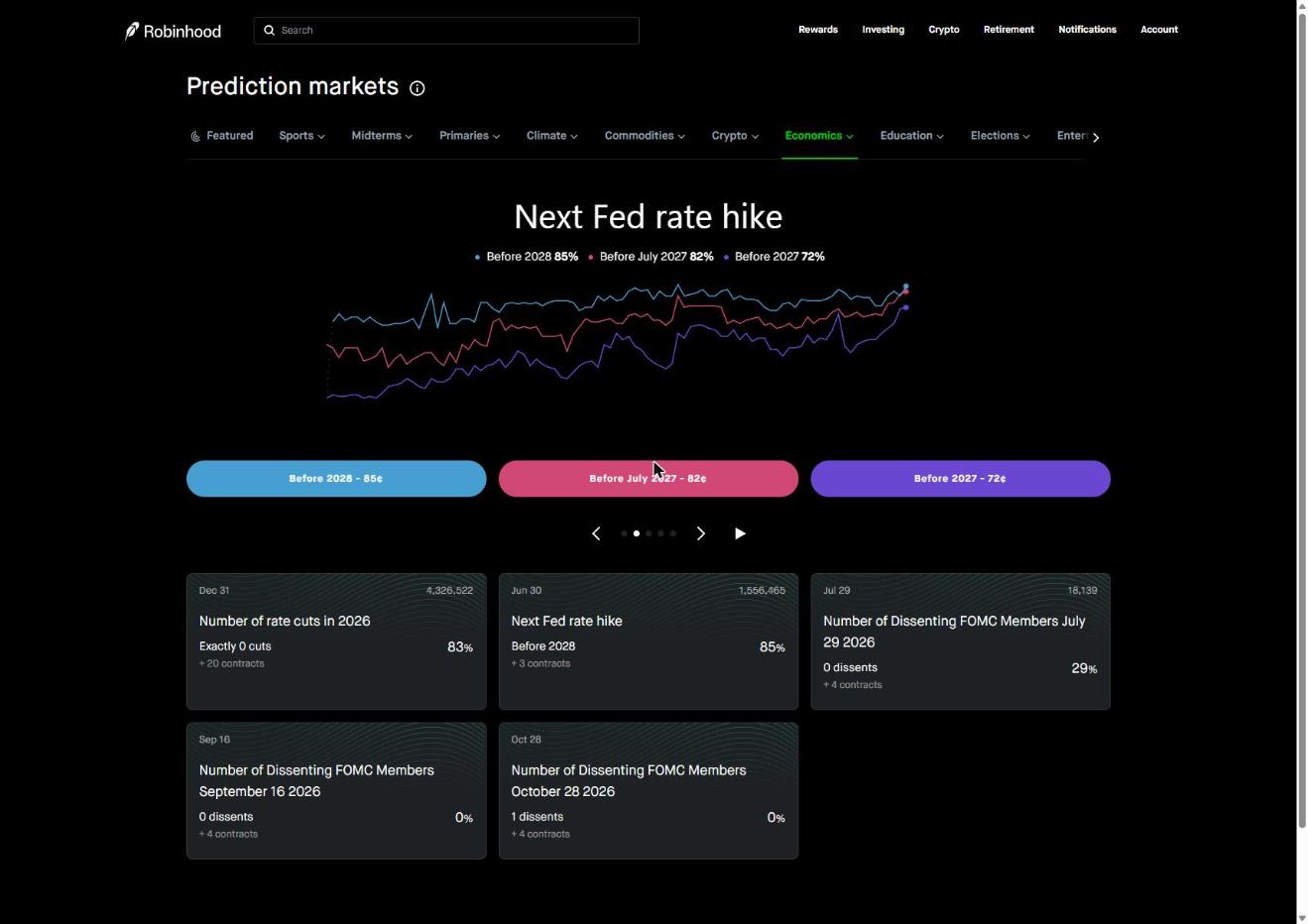
Event contract buying power is separate from your brokerage and crypto buying power, and it sweeps automatically between the two, and you can’t move it manually. Instant Deposits may not be available for event contracts, which means in some cases only fully settled cash can be used to open a position.
When a contract settles, proceeds land back in your buying power within one business day. An event that settles on a Friday may not leave you with usable funds until the following Monday.
Practically, this is also why opening and funding the account early is worth doing before you’ve picked a contract, not after: since event contracts draw on settled cash and a separate buying power pool, your funds need to already be in place and settled by the time you find a contract you want to trade, not still clearing.
Add Funds to Your Robinhood Account to Get Your Buying Power Ready
Taxes and Your Annual Statement
If you trade event contracts, Robinhood issues an event contracts annual statement after year-end, typically in late January or early February, covering your transactions, costs, proceeds, fees, and net profit or loss for the year. Robinhood states plainly that this statement is not a substitute tax reporting form. This article isn’t tax advice. If you trade event contracts, talk to a tax professional about how to report the activity.
The Risks: What Prediction Markets Are Not
None of the above is worth much without being direct about what can go wrong, so here it is straight:
- You can lose everything you paid for a contract. If a contract settles against you, it pays $0. That’s a total loss of the premium you paid for that position, not a partial one.
- Event contracts through Robinhood Derivatives are not FDIC insured and not SIPC protected. This is a meaningful distinction from Robinhood’s brokerage accounts: SIPC coverage applies to the brokerage entities (Robinhood Financial / Robinhood Securities), not to Robinhood Derivatives, which is where event contracts live. If you’re used to thinking of your Robinhood account as SIPC-protected, that protection does not extend to money in event contracts.
- A contract’s price is not a forecast. A $0.65 price means the market currently implies roughly a 65% chance. It doesn’t mean there’s a 65% chance, and it isn’t Robinhood (or anyone else) telling you what will happen.
- Event contracts are not bets, but they are speculative. Robinhood’s own language is that these are a form of speculation in prediction markets, not wagers against a house. That’s an accurate description of the mechanism, not a claim that the outcome is safer or more predictable than a bet would be.
- Nothing here is investment advice. This article explains how the product works; it doesn’t tell you which contracts to buy or which outcomes are more likely. That decision, and the risk that comes with it, is yours.
- The regulatory picture is still moving. The CFTC has open rulemaking on event contracts, and sports-based contracts specifically remain the most contested category, with state-level restrictions already in place in Maryland and Nevada. For the regulator’s own consumer guidance on this product, see the CFTC’s page on prediction markets and event contracts, which covers what you’re entitled to as a customer of a registered exchange and what to watch out for.
None of this makes event contracts illegitimate. They’re a regulated, CFTC-overseen product, offered by a licensed futures commission merchant, on licensed exchanges. It does mean the honest version of this product is “a way to take a position on a real-world question, with real and total-loss risk,” not “an easy way to make money,” and any coverage that skips the second half isn’t giving you the full picture.
Is Robinhood Predict Worth It?
Robinhood Predict makes the most sense for someone who is already comfortable with Robinhood, wants to take a small, defined-risk position on a specific real-world question, whether that’s a rate decision, an election or a crypto milestone, and understands going in that a wrong call means losing the full amount paid for that contract, not something smaller. The lower cost at high-conviction prices (near $0.01 or $0.99) also means it fits best with clear, high-confidence views rather than coin-flip questions, where the commission structure eats more of any edge.
It makes less sense for anyone looking for a substitute for a diversified investing strategy, anyone who isn’t prepared to treat the amount paid for a contract as money they could fully lose, and, given the mobile-only design and state restrictions, anyone who needs to trade from a desktop or who lives in Maryland (event contracts generally) or Nevada (new sports contracts specifically).
Ready to Take a Position? Open and Fund Your Robinhood Account
Frequently Asked Questions
Yes. Event contracts are CFTC-regulated derivatives offered through Robinhood Derivatives, LLC via KalshiEX, ForecastEX, or Rothera Exchange and Clearing. That said, they’re not available to Maryland residents, and Nevada residents can’t open new sports contracts.
A probability-weighted commission (5% of p×(1−p) with Gold, 10% without), capped at $0.01 per contract, plus an exchange fee of up to $0.01 per contract, charged on both opening and closing a position.
No. You can view contracts on the web, but trading is limited to the Robinhood mobile app, and it isn’t available on Robinhood Legend.
It settles at $0, and you lose the full amount you paid for that contract.
Settled proceeds typically reach your buying power within one business day, so a contract that settles on a Friday may not show usable funds until Monday.