
Searching for answers about whether a new investing app can be trusted with your money is a smart first step. If you’re asking “is plynk safe,” you’re already thinking like a careful investor. In this guide, we’ll break down everything you need to know about Plynk’s regulatory standing, investor protections, app security measures, and real-world user experiences to help you make an informed decision.
Quick Answer: Is Plynk Safe for Beginners?
The short answer is yes—Plynk is generally considered safe as a regulated U.S. brokerage platform. However, that doesn’t mean your investments are protected from market losses. There’s an important distinction between platform safety and investment safety that every beginner needs to understand.
Plynk’s brokerage services are provided by Digital Brokerage Services LLC (DBS), a FINRA-regulated broker-dealer and member of the Securities Investor Protection Corporation (SIPC), which protects investors when brokerages fail financially. This regulatory framework provides meaningful legal protections for eligible securities held in your brokerage account.
Crypto trading in the Plynk app works differently. Crypto services are offered through Paxos Trust Company, N.A., a federally regulated trust company. However, crypto assets are not protected by SIPC or the Federal Deposit Insurance Corporation (FDIC)—and that’s standard across the entire industry, not a Plynk-specific gap. The Plynk app uses multi-factor authentication, data encryption, and fraud detection to protect your accounts, but you still need to follow good security practices on your end.
If you want a full breakdown of fees, features, and user experience, read our complete Plynk review before deciding whether the app fits your investing style.
Key safety takeaways:
- Regulated by FINRA through Digital Brokerage Services LLC (DBS)
- SIPC coverage up to $500,000 per customer for eligible securities
- Crypto assets are explicitly excluded from SIPC and FDIC protection
- App-level security includes MFA, encryption, and ongoing monitoring
- Investments involve risk—no platform can eliminate market volatility

Who Is Behind Plynk and How Is It Regulated?
Plynk is a U.S.-based investment app designed for beginners who want to start investing with small amounts. It’s available on iOS, Android, and newer Apple devices (iOS 16.4+, macOS 13.3+ with Apple silicon, and visionOS 2.0+).
The brokerage services provided through Plynk come from Brokerage Services LLC (DBS), which is registered with the U.S. Securities and Exchange Commission (SEC) and regulated by FINRA. This means DBS must follow federal securities laws, maintain certain capital requirements, and submit to regulatory oversight and examinations.
Plynk-related brokerage accounts are protected by the Securities Investor Protection Corporation (SIPC). This coverage extends up to $500,000 per customer, including up to $250,000 for cash held in your account. This protection kicks in if the brokerage fails financially and your securities or cash go missing—not if your stocks simply drop in value.
For crypto services, the Plynk app partners with Paxos Trust Company, N.A. Paxos operates under supervision from the Office of the Comptroller of the Currency (OCC), which granted conditional approval for Paxos to convert to a national trust bank charter in December 2025. This federal oversight is significant, but it’s a different type of regulation than SIPC protection.
Plynk’s headquarters are located at 499 Washington Boulevard, Jersey City, NJ 07310. Having a physical U.S. presence and verifiable regulatory registrations helps distinguish Plynk from unregulated platforms or offshore schemes that sometimes target inexperienced investors.
Regulatory structure summary:
| Entity | Role | Regulator |
|---|---|---|
| Digital Brokerage Services LLC | Brokerage services | FINRA, SEC |
| SIPC | Investor protection | Federal nonprofit |
| Paxos Trust Company | Crypto services | OCC (federal) |
If you want a deeper look at Plynk’s investing tools, account types, and pricing structure, check out our full Plynk app review.
What this means for you:
- FINRA membership ensures compliance with securities rules
- SIPC membership provides a safety net if the brokerage fails
- Paxos/OCC regulation adds oversight to crypto custody
- Operating under U.S. frameworks means you have legal recourse
Account & Investment Safety: SIPC Coverage vs. Market Risk
Understanding the difference between “platform safety” and “investment safety” is crucial. Platform safety refers to custody protections, regulatory oversight, and SIPC coverage. Investment safety—or lack thereof—refers to market volatility and the risk that your assets lose value.
SIPC protects customers if the brokerage fails financially and securities are missing from your account. It does not protect you against market losses, bad timing, poor asset selection, or speculative bets that don’t pan out. Think of SIPC as insurance against the brokerage going bankrupt, not insurance against your stocks going down.
Through Plynk’s brokerage account, you can hold U.S. stocks, ETFs, mutual funds, and potentially traditional or Roth IRAs—all of which fall under DBS/SIPC protections in eligible accounts. You can trade stocks, find investments, and start investing with just a few clicks.
Even with SIPC and regulatory oversight, you can lose money due to:
- Stock and ETF price swings
- Mutual fund performance that fluctuates with market conditions
- Concentration risk from putting too much in one asset
- Speculative choices like meme stocks or volatile sectors
- Past performance not being a guarantee of future results
The Plynk app provides several tools to help manage risk and build consistent financial habits. These include:
- Simulated trading tools that let you practice investing with pretend money
- Educational content to summarize financial news and investment ideas
- Portfolio views showing your investments current activity
- Virtual portfolios to test strategies before you eventually invest real money
- Recurring investments to put consistent financial habits into action
These features help beginners learn, but none of them guarantee profits or prevent losses. When financial analysts discuss risk tolerance, they’re talking about your personal ability to weather potential losses—something no app can decide for you.
SIPC coverage boundaries:
| Covered | Not Covered |
|---|---|
| Securities held in brokerage accounts | Market losses |
| Cash up to $250,000 | Bad investment decisions |
| Missing securities if brokerage fails | Crypto assets |
| Up to $500,000 total per customer | Decline in asset value |
Is Plynk Safe for Crypto? Important Limitations and Risks
Crypto in the Plynk app is handled through Paxos Trust Company, N.A., which operates separately from your DBS brokerage account. This separation matters because the protections are completely different.
Let’s be explicit about what this means:
- Crypto assets in Plynk are not insured by SIPC or FDIC
- Crypto balances are separate from brokerage securities protection
- This is consistent with how most U.S. crypto platforms operate today
- No federal insurance program currently covers cryptocurrency losses
Trading crypto through Plynk involves risks that go beyond what you face with traditional securities. Cryptocurrency markets are highly speculative, and prices can swing dramatically in hours or even minutes.
Main crypto risks you should understand:
- Extreme volatility: Bitcoin, Ethereum, and other crypto assets can drop 20-50% in a single week
- Liquidity constraints: In fast-moving markets, you may have difficulty exiting positions at desired prices
- Market manipulation: Crypto markets are less regulated and more susceptible to manipulation than traditional securities
- Regulatory uncertainty: Rules around crypto taxation, trading, and availability continue to evolve
- No external wallet transfers: Plynk currently doesn’t allow you to move crypto to external wallets
Paxos does provide some regulatory assurance. As a trust company under OCC supervision, Paxos must meet capital requirements, custody standards, and compliance obligations. However, this regulation doesn’t remove market risk, hacking risk, or smart-contract vulnerabilities inherent to crypto assets themselves.
It’s worth noting that Paxos was subject to a consent order from the New York Department of Financial Services in September 2025, resulting in a $26.5 million penalty for AML compliance deficiencies. While this action related to Paxos’s broader business relationships (including stablecoin issuance), it demonstrates that even regulated crypto providers face significant scrutiny and enforcement.
Plynk provides crypto education and in-app risk disclosures, encouraging users to only invest what they can afford to lose. The platform presents crypto services alongside traditional securities, helping users keep perspective on the different risk profiles.
Crypto safety takeaways:
- No SIPC or FDIC coverage for crypto holdings
- Paxos is OCC-regulated, adding some oversight
- Crypto remains highly speculative with significant volatility
- Regulatory landscape continues to shift
- You cannot currently transfer crypto out of the Plynk app

App Security: How Plynk Protects Your Data and Login
When we talk about safety, cybersecurity matters just as much as regulatory protection. How does Plynk protect your login credentials, personal data, and financial information?
Key security measures Plynk highlights:
- Multi-factor authentication (MFA): Required for account access, adding a second verification step beyond your password
- Data encryption: Industry-standard encryption for data in transit (moving between your device and servers) and at rest (stored on servers)
- Fraud detection: Automated systems that monitor for suspicious activity around the clock
- Third-party identity verification: When you open or manage an account, Plynk uses external verification services to confirm your identity
Plynk follows Know Your Customer (KYC) and anti-money laundering (AML) requirements, which is why the app asks for your Social Security number, address, and date of birth when you sign up. These requirements are mandated by federal regulations, not optional data collection.
As of late 2024 and early 2025, there have been no widely reported data breaches specifically related to Plynk. That said, no app can promise zero cyber risk, and security practices evolve constantly in response to new threats.
Practical security tips for Plynk users:
- Enable MFA and biometric login wherever available—don’t skip this step
- Keep your phone’s OS and the Plynk app updated to patch security vulnerabilities
- Avoid using public Wi-Fi for trading, bank account changes, or sensitive account activity
- Never share one-time codes or passwords with anyone claiming to be Plynk support
- Use a unique, strong password that you don’t reuse across other apps or sites
- Lock your device with a PIN, fingerprint, or face recognition
If someone contacts you claiming to be from the Plynk team and asks for login credentials or verification codes, that’s a red flag. Legitimate support will never request this information through unsolicited calls or messages.
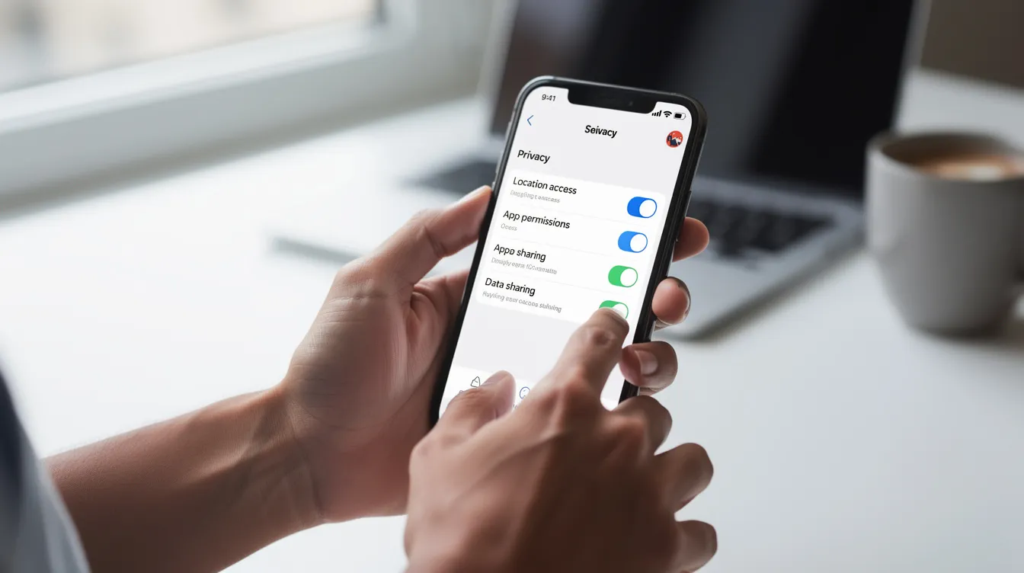
Data Privacy: How Plynk Uses and Tracks Your Information
A safe investing experience also depends on how your personal and financial data is collected, stored, and shared. Understanding Plynk’s data practices helps you make informed decisions about your privacy.
Based on app store disclosures, Plynk may use data to track users across apps and websites owned by other companies. Tracked data can include identifiers and usage patterns to support analytics and personalized marketing—this is increasingly common across mobile apps in clear and simple language that regulatory filings require.
Data that may be linked to you includes:
- Contact information (name, email, phone number)
- Financial details (account balances, transactions, bank account connections)
- App usage patterns and device identifiers
- Location data and browsing behavior within the app
This data serves multiple purposes: account servicing, fraud prevention, regulatory compliance, and improving the app experience. Some of it is legally required for KYC/AML compliance.
Privacy steps for cautious users:
- Review Plynk’s current Privacy Policy and Terms inside the app or on plynkinvest.com
- Check what permissions the app has on your device (camera, contacts, location, tracking)
- Use iOS or Android privacy controls to limit cross-app tracking
- Understand that declining some tracking may reduce personalization but increases privacy
- Periodically audit connected bank accounts and remove any you no longer use
When app store listings mention “data used to track you,” they’re referring to information that can follow your activity across multiple apps and websites for advertising purposes. “Data linked to you” means information tied directly to your identity. Both categories appear in Plynk’s disclosures, which is standard for financial apps that serve retail clients.
User Experiences, Complaints, and How to Get Help
Beyond technical safeguards and regulations, real-world user experiences help evaluate whether an app feels safe and responsive in practice. Here’s what we know about Plynk’s track record with users.
The Better Business Bureau (BBB) hosts a Plynk-related profile showing complaints and reviews over a rolling three-year period. The profile shows 7 complaints over 3 years, with 4 in the past 12 months. However, context matters—BBB does not independently verify all third-party information, and raw complaint counts tell you less than how a company responds and resolves issues.
Common complaint themes across BBB and Trustpilot include:
- Difficulty withdrawing funds or updating bank account information
- Accounts placed on hold for “pending review” without clear timelines
- Customer service response times and limited phone support
- Issues with third-party identity verification during account setup
Trustpilot reviews show polarized opinions—a mix of satisfied users who appreciate the app’s simplicity and frustrated users who encountered service issues. When you discover unsure feelings reading reviews, look for patterns rather than isolated incidents.
For a deeper breakdown of real user reviews, pricing, and features, see our complete Plynk review.
How to reach Plynk support:
| Channel | Details |
|---|---|
| In-app support | “Contact Us” feature for secure messaging |
| service@plynkinvest.com | |
| Corporate address | 499 Washington Boulevard, Jersey City, NJ 07310 |
If you encounter issues:
- Start with in-app help or FAQs for common questions
- Document problems with screenshots and timestamps
- Use email (service@plynkinvest.com) for issues requiring a paper trail
- Keep records of all communications
- For unresolved matters, consider escalating to FINRA or your state securities regulator
In December 2025, FINRA fined Digital Brokerage Services LLC $85,000 for distributing potentially misleading retail communications about crypto assets. The issues involved marketing language that didn’t adequately disclose risks or clarify which entity provided crypto services versus brokerage services. DBS agreed to withdraw or update the problematic content. This enforcement action shows that regulators actively monitor platforms like Plynk—which is actually a sign that the system is working.
Bottom Line: Is Plynk a Safe Choice for You?
Plynk operates within the U.S. regulatory framework through Digital Brokerage Services LLC (FINRA member, SIPC member) for brokerage services and Paxos Trust Company for crypto. This regulatory foundation provides a strong safety baseline compared to unregulated platforms or offshore operations. For beginners wondering “is plynk safe,” the answer is that it meets the standard requirements you’d expect from a legitimate U.S. investment platform.
Securities held in eligible brokerage accounts have SIPC protection up to $500,000, including up to $250,000 in cash. This covers you if the brokerage fails financially—not if your investments lose value. Crypto assets in Plynk carry no SIPC or FDIC insurance and come with significantly higher volatility and regulatory uncertainty. These aren’t Plynk-specific limitations; they reflect the current state of crypto regulation across the industry.
Plynk adds multiple layers of technical security through multi-factor authentication, data encryption, fraud detection, and ongoing monitoring. The app also offers educational tools, a simulated trading tool for paper trading with a virtual trading experience, and small-dollar investing starting at $1. These features help beginners practice investing and build habits more cautiously before committing larger amounts. The ability to see how your investments would’ve performed in simulated scenarios provides valuable learning without risking your full value.
Before deciding if Plynk is right for you, consider:
- Your risk tolerance: Can you handle seeing your account value drop temporarily?
- Your financial goals: Is this money you can afford to leave invested for years?
- Comfort with mobile-only investing: There’s no desktop interface currently
- Views on data tracking and privacy: Are you comfortable with the data practices disclosed?
- Feature needs: Plynk doesn’t offer automated rebalancing, human advisors, or other expenses management tools
The Plynk app is designed for people who want to start investing without complexity. It won’t charge interest charges for basic accounts, helps you separate expenses from investments, and encourages putting consistent financial habits in place through recurring investments. However, recurring investments require discipline, and the platform doesn’t provide personalized advice based on your individual financial circumstances.
Plynk can be a solid, relatively low-friction way for new investors to begin their investing journey. The platform passes the basic safety tests: regulated brokerage services, SIPC membership, federal oversight for crypto custody, and reasonable app security measures. What it can’t do is eliminate the market risk inherent in investing or guarantee that your choices will lead to positive actual performance returns.
If you’re ready to start, consider using the simulated trading features first. Practice with pretend money, explore investing opportunities, and get comfortable with how the app works. When you do invest real money, remember that past performance offers no guarantee of future results, and investments involve risk regardless of which platform you choose security Plynk or any other.
Before opening an account, you may want to read our full Plynk review, where we analyze the app’s fees, features, and beginner tools in detail.
Core safety takeaways:
- Regulated by FINRA with SIPC membership for brokerage accounts
- Crypto services through OCC-regulated Paxos, but no SIPC/FDIC coverage
- Strong app security with MFA, encryption, and fraud detection
- Mixed user reviews—some service delays reported, but regulatory oversight exists
- Market risk remains your responsibility regardless of platform safety
- Start small, use educational tools, and invest only what you can afford to lose